
Written by Steve Rhode, consumer debt expert since 1994 • Last updated October 30, 2026
Quick Answer: If your school closed while you were enrolled, or you left it shortly before it closed, or you borrowed a Parent PLUS loan for a student in that spot, and you (or the student) did not finish your program through a teach-out or by transferring credits, your federal student loans can be discharged: the balance is wiped out, you qualify for a refund of what you paid, and the loan’s bad credit history is deleted (20 U.S.C. § 1087(c), 34 CFR § 685.214(b)). How close to the closing you had to leave depends on when each loan was first disbursed: 120 days for loans first disbursed before July 1, 2020, and 180 days for loans first disbursed on or after that date. If you left earlier than your window, apply anyway and explain why: the Department can extend the window for exceptional circumstances. For those newer loans you must also certify that you have not accepted an approved teach-out. Being in default does not bar you from applying. The closure alone doesn’t stop the bills, so send the application and ask your servicer in writing to pause billing while the Department decides. Private loans aren’t covered, but you may have other options.
What Just Happened to Your Loans
Your student loan is a contract between you and the lender, which for a federal loan is the U.S. Department of Education. It is not a contract with the school. So when the school closed, the loan didn’t go anywhere, and your servicer’s system doesn’t know or care that you never got to finish. The bill keeps arriving.
Congress saw this coming. The Higher Education Act says that when a student is “unable to complete the program in which such student is enrolled due to the closure of the institution,” the Secretary “shall discharge the borrower’s liability on the loan (including interest and collection fees)” (20 U.S.C. § 1087(c)(1)). Direct Loans carry the same terms, conditions and benefits as the older FFEL loans unless the statute says otherwise (20 U.S.C. § 1087e(a)(1)), and the Department’s rule for Direct Loans is 34 CFR § 685.214. GEN-25-04 also names § 682.402(d) (FFEL) and § 674.33(g) (Perkins). I verified the 2020 Direct Loan text only, and the live eCFR pages for those two still show the later wording, so ask your loan holder in writing which closed-school text it applies to your loan.
Which version of the rules applies. A 2025 federal law put back the 2020 version of these rules for loans made before July 1, 2035. The Department’s own Dear Colleague Letter, GEN-25-04 (July 18, 2025), says the closed school discharge regulations that took effect July 1, 2020 “will be effective as if the regulations were never amended,” and that they apply to “any loans originated prior to July 1, 2035.” The letter says the Department planned to publish a Federal Register notice restoring that text, and the eCFR text for § 685.214 that I pulled, current through October 28, 2026, still printed the later 2023 wording. So a rule page you find online may not match what governs your loan. I built this guide from the text of § 685.214 as it read on August 17, 2021, which is the 2020 version.
The date your loan was first disbursed decides your window. The rule splits by that date. For loans first disbursed before July 1, 2020, you can qualify if you withdrew not more than 120 days before the school closed (§ 685.214(c)(1)(i)(B)). For loans first disbursed on or after July 1, 2020, the look-back is 180 calendar days (§ 685.214(c)(2)(i)(B)). You can have both kinds of loans, so check each one. The loan details on StudentAid.gov are where I’d look for the disbursement dates. I couldn’t open a logged-in account to confirm exactly how that page labels them, so if you can’t find the first disbursement date for a loan, ask your servicer for it in writing.
Here is how the process is supposed to work. After the Department confirms the closure date, it identifies borrowers who appear to have been enrolled on that date or to have withdrawn within the window, mails them a discharge application if it has a current address, and promptly suspends collection on the affected loans, although it “may continue to receive borrower payments” (§ 685.214(f)(1)–(2) for older loans, § 685.214(g)(1)–(2) for newer ones). Whether the Department discharges without an application depends on the closure date. If it determines from information it already has that you qualify, it may discharge the loan without an application. It will do so only for schools that closed on or after November 1, 2013 and before July 1, 2020, and only if you did not re-enroll in any title IV-eligible school within three years of the closure (§ 685.214(c)(3)). For any other closure, nothing in the rule promises you an automatic discharge.
The phrase to notice is “information in the Secretary’s possession.” If the records are wrong about your enrollment, your dates, or whether you finished, you won’t be on anyone’s list. And the mail goes to the address on file. That is why I don’t want you waiting on it.
The Mistake You’re About to Make: Waiting for an automatic discharge, or assuming the closure cancelled the bill, and letting the loans go delinquent in the meantime. The Government Accountability Office looked at the old automatic process that waited 3 years after a closure (GAO-21-105373). More than 70% of borrowers who eventually got that old automatic discharge were in default or past due. Don’t wait to find out where you’d land. Do this instead: apply now, in writing, and ask for billing to be paused while the Department decides. Two more traps while you’re at it. Don’t pay a company to file this form (it is a form you send to the Department, and nothing in it involves a fee), and don’t accept a teach-out before you read the teach-out question in the FAQ below, because on newer loans accepting one can cost you the discharge.
Your Options Right Now
What to Do in the Next 48 Hours
- Find out which of your loans are federal, and when each was first disbursed. Log in at studentaid.gov, where your federal loans and their servicers are listed. Only federal loans (Direct, FFEL and Perkins) are covered by this discharge, and for loans first disbursed before July 1, 2020 the rule asks for loan proceeds received on or after January 1, 1986. Write down the first disbursement date of each loan, because it decides whether your window is 120 or 180 days. A loan that isn’t listed there is probably private, so check your credit report for the lender’s name and jump to Step 4.
- Write down your dates and gather proof. You need the closure date, your last day of attendance, any approved leave of absence, the name of your program, and whether you were offered a teach-out and what you did with it. If you left outside your window, write down why. Save the enrollment agreement, transcripts, closure notices and any emails.
- Send the closed school discharge application, and ask your servicer in writing to pause billing while it is decided. Use the Department’s own school closure discharge application and send it where the form’s instructions say. For older loans the rule asks for a written request and a sworn statement (it need not be notarized), and for newer loans a completed application, both made under penalty of perjury, so answer every item truthfully, including any claim you made or payment you received from a third party such as a performance bond or tuition recovery program. Keep proof of mailing. If the Department has already mailed you an application, you have 60 days to return it before collection resumes (§ 685.214(f)(4), (g)(4)). If you miss that date, the rule says collection resumes with forbearance for the paused period, and the interest that built up during the pause may be added to your balance. Missing it restarts collection; it is not a deadline for applying.
- If you don’t qualify, or your loans are private, don’t stop at “no.” If your school lied to you, look at borrower defense, which is a separate claim with its own rules (my post on Sweet v. McMahon explains the background, and the same 2025 law changed which borrower defense rules apply, so check the Department’s current page before relying on any dates). For private loans, read my guide to the Holder Rule defense. Student loans can be discharged in bankruptcy, federal ones on a showing of undue hardship and some private ones outside the student loan exception altogether (11 U.S.C. § 523(a)(8)). If your wages are already being garnished, the automatic stay (11 U.S.C. § 362) takes effect the moment you file, so see a bankruptcy attorney the same day. If the discharge is approved, money already taken by enforced collection is reimbursable (§ 685.214(b)(2)), so tell the attorney that too. Find one through NACBA and use my bankruptcy quiz to see where you stand.
- Get a second set of eyes. Schedule a free consultation with Damon Day, an independent debt coach (not an attorney) and my podcast co-host. I receive no payment for this referral.
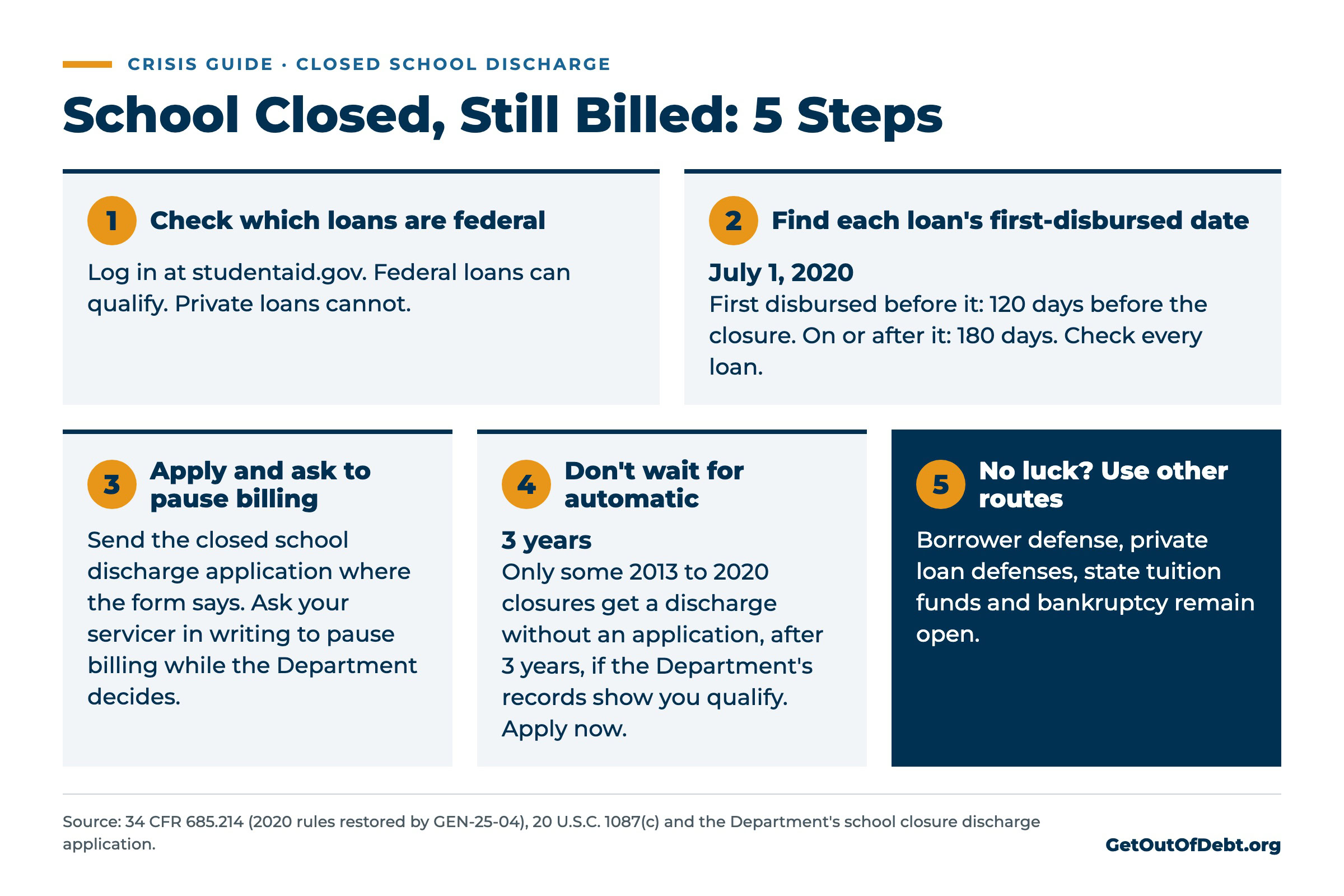
How to Actually Stop It — Your 5 Paths
- Closed school discharge (federal loans). Start here if you qualify. It is free, it needs no lawsuit, and if it is approved the balance is discharged, you qualify for a refund of what you paid, and the adverse credit history is deleted (§ 685.214(b)). Bankruptcy usually leads my lists, and I’m putting it fourth here on purpose: for a federal loan tied to a school that closed on you, this route costs nothing, refunds what you paid, and cleans up the credit history. That is not the same as fast. If a paycheck is being taken right now, the stay from a bankruptcy filing works on filing, so call a bankruptcy attorney the same day you mail the form.
- If you don’t qualify: borrower defense and your state’s tuition fund. Borrower defense is a different claim for borrowers whose school misled them. Some states run tuition recovery funds. The Department’s form asks about any payment from one (see the California example below).
- Private loans: the Holder Rule and state law. Many private student loan notes carry a clause letting you raise your school’s misconduct against whoever holds the loan, and the CFPB has documented servicers telling borrowers no such option existed. See my breakdown.
- Bankruptcy, still one of the strongest tools I know, and a backstop for any student loan. It is real and it works for some borrowers, but for a federal loan it means proving undue hardship, which is a harder case than closed school discharge, and that is why it sits behind it here. The automatic stay stops collection the moment you file. My posts on student loans in bankruptcy and private loans in bankruptcy explain the tests.
- What won’t work. Ignoring the bills, stopping payments with no paperwork, or paying a “forgiveness” company to file a free form (here is how that pitch works). I’d also hold off refinancing a federal loan into a private one while a closure is in play: the discharge rules are written for the federal loan, and I can’t promise what happens to a loan that was refinanced away.
What You Need to Know About the Rules
120 or 180 days
How long before the closure you could have withdrawn and still qualify: 120 days for loans first disbursed before July 1, 2020, 180 days for loans first disbursed on or after it (§ 685.214(c)(1)–(2)).
July 1, 2020
The first-disbursement date that decides which window, and which paperwork, applies to each of your loans (§ 685.214(c)).
60 days
How long you have to return an application the Department mailed you before collection resumes (§ 685.214(f)(4), (g)(4)). Missing it restarts collection; it is not a deadline for applying.
3 years
The re-enrollment gap that triggers a required discharge without an application (if the Department’s records show you qualify), and only for schools that closed from November 1, 2013 to before July 1, 2020 (§ 685.214(c)(3)).
One warning about the Department’s forms. The current application, as I read it on October 30, 2026, says 180 days, says you may be automatically eligible one year after the closure, treats a student who accepted but did not finish a teach-out as eligible, and does not split loans by disbursement date. That wording matches the version of the rules the 2025 law delayed, not the 2020 rules the letter restored. I’d still use the Department’s form, but go by the rule that governs your loans, and if the form and the rule point different ways, say so in a short cover letter. GEN-25-04 also names § 682.402(d) (FFEL) and § 674.33(g) (Perkins). I verified the 2020 Direct Loan text only, and the live eCFR pages for those two still show the later wording, so ask your loan holder in writing which closed-school text it applies to your loan.
| Your situation | Closed school discharge? | What to do |
|---|---|---|
| You were enrolled on the day the school closed | Yes, if you did not complete the program through a teach-out or a credit transfer. On a loan first disbursed on or after July 1, 2020, you also must not have accepted an approved teach-out or still be in one. | Apply now. Don’t wait for an automatic discharge. |
| You were on an approved leave of absence when it closed | Not settled by the 2020 text. The Department’s current form says a student on approved leave is considered still enrolled (application form), but that comes from the current form, which describes the delayed rules, and it is not in the 2020 Direct Loan text I read. | Apply, give the leave dates, and ask in writing for a decision under the 2020 rule. |
| You withdrew no more than 120 days before it closed, and the loan was first disbursed before July 1, 2020 | Yes (§ 685.214(c)(1)(i)(B)) | Apply and be precise about your last day. |
| You withdrew no more than 180 days before it closed, and the loan was first disbursed on or after July 1, 2020 | Yes, and you must also certify that you have not accepted an approved teach-out (§ 685.214(c)(2)) | Apply and be precise about your last day. |
| You withdrew before your window began (more than 120 or 180 days, depending on the loan) | Possibly. The Secretary may extend the window if exceptional circumstances justify it. The rule lists examples such as loss of accreditation or a revoked state license, and the list differs by loan date (§ 685.214(c)(1)(i)(B), (c)(2)(i)(B)). | Apply anyway and say truthfully which circumstance fits. |
| You accepted a teach-out | Depends on the loan. For loans first disbursed on or after July 1, 2020, you must certify you have not accepted an approved teach-out or are not continuing in one (§ 685.214(c)(2)(ii)). The rule does not say how the Department treats someone who accepted one and then quit. | Don’t guess. Describe the teach-out honestly and ask for a written answer. |
| You completed the program, including through a teach-out or by transferring credits to another school | No, you finished (§ 685.214(c)(1)(i)(C), (c)(2)(i)(C)) | If the school misled you, look at borrower defense. If the school reported a lower credential than the one you were pursuing, tell the Department and bring proof; the form says you may become eligible. |
| You took online classes | Ask first. The Department’s form says distance education students are eligible only if the main campus closed, and the rule dates the closure from when the school stops instruction in all programs (§ 685.214(a)(2)(i)). | Ask the servicer in writing how it treats your school’s closure date. |
| Your loan is private | No. The statute covers loans made, insured or guaranteed under the federal programs. | See the Holder Rule path above, and ask your lender in writing whether it has any closure policy. |
One live dispute worth knowing about. On October 29, 2026, NPR reported that the nonprofit Student Defense had sued the Department of Education on behalf of a former Brooks Institute student and potentially thousands of other borrowers, alleging the Department is refusing to honor a January 2025 order that, as NPR described it, expanded the look-back window under the Department’s “exceptional circumstances” authority. NPR said the Department told it that it “stands by its implementation of the program.” Those are the plaintiffs’ allegations, not a ruling, and I can’t tell you how it ends or how it fits with the 2020 rules described above. What it means for you: if you left before your window began, apply anyway and say why, because the regulation lets the Secretary extend the window (§ 685.214(c)(1)(i)(B), (c)(2)(i)(B)).
If you live in California, the Bureau for Private Postsecondary Education runs the Student Tuition Recovery Fund, which the Bureau says “relieves or mitigates economic loss suffered by a student while enrolled in a qualifying institution,” generally one the Bureau approved or registered. At enrollment you must have been a California resident or enrolled in a residency program, prepaid tuition, and suffered economic loss. Claims have deadlines, so check the Bureau’s current application now. In other states, ask your state’s postsecondary authorizing agency whether a similar fund exists. File any state-fund claim now and meet its deadline; don’t wait for a discharge. On discharge, § 685.214(e)(1) treats you as assigning to the Department any right to a loan refund you have by contract or law with respect to the loan or the enrollment agreement, up to the amount discharged, against the school and any private fund, including the portion of a public fund that represents money received from a private party, so ask the fund how a later discharge affects your claim. See my complete guides to student loan crises for more.
If your servicer ignores the application, or someone is collecting while it is pending, file a complaint with the CFPB, your state attorney general, and the Department’s Federal Student Aid Ombudsman Group. If you need legal help but can’t afford an attorney, find free legal aid through LSC.gov. If a paycheck is already being garnished over this loan, read my garnishment guide at the same time.
Steve’s Take
I filed bankruptcy in 1990, and I know the particular shame of a bill for something that didn’t work out. A school closing isn’t a failure you caused. You did what you were told: you enrolled, you borrowed, you showed up. The institution is the one that failed. Debt is math wrapped in emotion, and the math here is simple: a federal loan tied to a school that closed on you may be erasable for free, with a refund of what you paid. The emotion is the voice that says don’t open the mail. Open the mail. Put your dates in writing, send the form, and keep copies. And if the rules don’t fit your situation, you still have routes, including bankruptcy, which I’d rather you know about than be talked out of.
Frequently Asked Questions
My school closed and I’m still being billed — do I have to keep paying?
Until a loan is actually discharged it is still a live loan, so the bills keep coming and missed payments can hurt you. I’d do two things. First, send the closed school discharge application and ask your servicer in writing for forbearance while the Department decides. The Department’s forbearance rule lists the period needed to determine your eligibility for a closed school discharge among the situations where the Secretary grants forbearance without documentation from you (34 CFR § 685.205(b)(6), as the eCFR prints it today), and once the Department mails you an application it promptly suspends collection (§ 685.214(f)(2), (g)(2)). Neither of those means the bill stops by itself, so ask, and keep proof you asked. Second, if you can afford it, paying in the meantime isn’t wasted if you’re approved, because a discharge qualifies you for reimbursement of amounts paid voluntarily or through enforced collection (§ 685.214(b)(2)), but never at the price of rent or groceries. If you’re denied, the loan is still yours to repay, so keep your records and move to Step 4.
Will my loans be wiped out automatically — how long do I have to wait?
Maybe, and maybe not, so I wouldn’t wait. If the Department determines from information it already has that you qualify, it may discharge a Direct Loan without an application. It will do so only for schools that closed on or after November 1, 2013 and before July 1, 2020, and only if you did not re-enroll in any title IV-eligible school within three years of the closure (§ 685.214(c)(3)). For other closures the rule makes no such promise. And the discharge depends on the Department’s records being right, while applying costs you nothing and doesn’t wait on a clock. I’d apply.
I left my school a few months before it closed — can I still get a discharge?
Maybe. It turns on when your loan was first disbursed. For loans first disbursed before July 1, 2020, the rule covers borrowers who withdrew not more than 120 days before the school closed (§ 685.214(c)(1)(i)(B)). For loans first disbursed on or after that date, the window is 180 calendar days (§ 685.214(c)(2)(i)(B)). If you left earlier than that, the Secretary may extend the window for exceptional circumstances. For older loans the rule’s examples include the school’s loss of accreditation, the school discontinuing the majority of its academic programs, state action to revoke its license, and a finding by a State or Federal agency that the school violated law. For newer loans the examples include revocation or withdrawal of the school’s accreditation or state authorization, the Department ending the school’s participation in a title IV program, a teach-out that outlasts the 180-day look-back, and a teach-out school that fails to perform the teach-out agreement. The lists say “may include, but are not limited to,” and the decision is the Secretary’s. See also the lawsuit I described above.
What do I actually get if the discharge is approved?
Four things, all in § 685.214(b): you are relieved of the loan and any accrued charges and collection costs, you qualify for reimbursement of what you paid voluntarily or through enforced collection, a loan you had defaulted on is no longer treated as in default and you can receive federal aid again, and the Department reports the discharge to the credit bureaus so as to delete the adverse history. The statute adds that your time at the closed school doesn’t count against your eligibility for additional federal aid (20 U.S.C. § 1087(c)(3)). Two catches: if you consolidated, the current form says only the portion that represents the eligible original loans is discharged. That comes from the current form, which describes the delayed rules, and it is not in the 2020 Direct Loan text, so when you apply, say which loans were consolidated and ask in writing for a decision under the 2020 rule. And upon discharge you are treated as having assigned to the Department any right to a refund, up to the amount discharged, that you have against the school and certain funds (§ 685.214(e)(1)). On taxes, the IRS says a borrower whose federal loan is discharged through the closed school process “will not recognize gross income as a result of the discharge” (Rev. Proc. 2020-11), and that is the federal rule only — state tax is a separate question to ask a tax professional in your state.
My school offered a teach-out — should I take it?
A teach-out is an arrangement, approved by the school’s accreditor and, where one applies, the state agency, that gives you a chance to finish your program. Here is what the rule says. For loans first disbursed before July 1, 2020, you state that you did not complete your program through a teach-out at another school or by transferring credits you earned at the closed school to another school (§ 685.214(c)(1)(i)(C)). For loans first disbursed on or after that date, you certify the same about your program or a comparable program, and you also certify that you have not accepted the opportunity to complete, or are not continuing in, the program or a comparable program through an approved teach-out (§ 685.214(c)(2)(i)(C), (ii)). So on newer loans, saying yes to a teach-out can cost you the discharge. I can’t tell from the rule how the Department treats someone who accepted a teach-out and then quit, so get an answer in writing before you accept one. That isn’t a reason to refuse one. If a teach-out gets you a credential you can actually use, that may be worth more to you than a discharge. It’s your call, and I want you to make it knowing the trade. Get the agreement in writing and find out exactly which of your credits it accepts before you sign.
Free Tool — Contract Decoder: Have a contract from a debt relief company? The free Contract Decoder analyzes it for red flags, hidden fees, and problematic terms — before you sign anything. Decode My Contract →
My loans are private — is there anything like this?
Not a federal closed school discharge. The statute applies to loans “made, insured, or guaranteed” under the federal program (20 U.S.C. § 1087(c)(1)). But the CFPB reports that many private student loan contracts include a provision, which the FTC’s Holder Rule (16 CFR § 433.2) may require, letting you assert claims against your school against any later holder of the loan (CFPB Supervisory Highlights, Issue 36). The notice itself caps recovery at the amounts you paid. Whether a school’s closing gives you a claim depends on your state’s law and your contract, so have a consumer attorney (NACA) read the note. My posts on the Holder Rule and private loans in bankruptcy go deeper.
Can I discharge student loans in bankruptcy?
Yes. Student loans can be discharged in bankruptcy — federal loans on a showing of undue hardship, and some private loans fall outside the student loan exception altogether (11 U.S.C. § 523(a)(8)). The Justice Department publishes guidance on how it evaluates undue hardship cases, and I cover it in my post on student loans in bankruptcy. For a federal loan from a closed school I’d try the free closed school discharge first, because bankruptcy means an adversary proceeding and a hardship showing. The automatic stay (11 U.S.C. § 362) takes effect the moment you file, which is why a bankruptcy attorney is worth a call the same day if your wages are being garnished or collection is already underway.
I live in California — is there any other money available when my school closes?
Possibly. The Student Tuition Recovery Fund exists to relieve or mitigate economic loss suffered by a student while enrolled in a qualifying school, and you must have been a California resident or in a residency program at enrollment, prepaid tuition, and suffered economic loss. Check the Bureau’s current application and deadlines promptly. Whatever state you’re in, the Department’s application asks whether you’ve made a claim with a tuition recovery program or received a payment, so report it accurately, and ask your state attorney general (usa.gov) or your state’s postsecondary authorizing agency what exists where you live.
One more thing — everything I share here is based on more than 30 years of helping people through exactly this. But my advice is input for your decision, not the decision itself. Only you know your full situation. Talk to an attorney, look at your numbers, and make the choice that serves your future.
Important: This guide is for informational purposes only and is not legal advice. Laws vary by state, and your situation may have details that change what options are available to you. For legal advice specific to your case, consult an attorney licensed in your state. NACBA can help you find a bankruptcy attorney, NACA can connect you with a consumer attorney, or schedule a free consultation with Damon Day, an independent debt coach and my podcast co-host — I receive no payment for this referral.
Key Takeaway: A school closing is serious but not the end of the story. If you were enrolled, or left within your window (120 days for loans first disbursed before July 1, 2020, 180 days for loans first disbursed on or after it), and you didn’t finish through a teach-out or a credit transfer, apply for the closed school discharge now and ask in writing for billing to pause. On newer loans, don’t accept a teach-out without getting an answer in writing, because you must certify you haven’t. Default doesn’t bar you from applying. Keep your dates and copies, talk to an attorney this week if you don’t qualify or the loans are private, and use the Find Your Path quiz to see where you stand. Don’t wait for the Department to find you.
The Bottom Line
You are not bad with money. You trusted a school with your future and it closed on you. The law saw that coming and gave you a way out, and the borrowers who do best are usually the ones who put their dates and their request in writing and keep copies. If someone you know went to a school that closed and is still getting bills, send them this page — they may not know the loan can be erased. See the Crisis Guides hub for related situations, or my checklist on federal loans when a school closes.
Dealing With Debt? Understanding your options is the first step. See how all your debt relief options compare — including ones most sites won’t tell you about. The Find Your Path quiz gives a recommendation based on your actual numbers, and the Scam-O-Meter checks any company’s complaint history before you sign. Federal Reserve Bank of New York research shows bankruptcy filers recover faster than those who don’t file.
Right now you are dealing with the thing in front of you, and that is exactly where your attention belongs. When it is handled — and it will be — there is a next stage, and it is the one I most enjoy writing about.
In the latest issue (Nov 6): Owed money on an Amazon return? Check by Dec. 1
Each weekday I send one short email: one story that caught my attention, why it might matter to you, and one manageable thing you can do with it. It is free, I sell nothing, and I take no money from any company I write about.



Hi Melissa,
There are very limited options for dealing with student loan debt.
Your school being closed may open opportunities to you for handling the debts that would not otherwise be available.
A great resource for looking at the options for dealing with student debt, including your situation, is http://www.studentloanborrowerassistance.org/loan-cancellation/problems-with-your-school/closed-school/
Your withdrawal from the school having been a couple years ago may hinder your loan qualification.