Quick Answer: A new proposal from the Committee for a Responsible Federal Budget would cap Social Security cost-of-living adjustments for higher-income retirees, while the trust fund is now projected to run out in 2032 — triggering automatic benefit cuts of up to 23%. These two forces are squeezing Social Security from both directions. Whether you’re near retirement or already on it, the math just changed.
“Every financial advisor says ‘plan for full benefits.’ I’ve spent 30 years watching people plan around promises that Washington quietly breaks.”
Two things happened in the same week that should have every person within 10 years of retirement recalculating their numbers. The Committee for a Responsible Federal Budget proposed capping Social Security COLAs for higher-income retirees, and the Motley Fool laid out a sobering analysis: Congress has about 6 years to fix Social Security before automatic benefit cuts kick in.
Neither story alone would keep me up at night. Together, they tell you something the headlines aren’t saying: Social Security is being squeezed from two directions at once, and the people who’ll feel it most are the ones already carrying debt into retirement.
Every weekday I read the enforcement actions, filings and fine print the outlets skip, and turn them into the one or two moves that actually improve your position — a rate worth moving for, a fee you can refuse, a deadline to beat before it costs you.
In the latest issue (Oct 7): Pissed Off Pays More
I write Your Money Actually most weekdays — actionable money information you will not find anywhere else, and the small decisions that compound. It is free, I sell nothing, and I take no money from any company I write about.
What You Need to Know
There are two separate forces converging here. Understanding both matters, because the people giving you advice about Social Security are usually only talking about one.
Force #1: The COLA Cap Proposal
The Committee for a Responsible Federal Budget — a bipartisan nonprofit, not a fringe group — is proposing to limit annual cost-of-living adjustments for retirees who receive the highest benefits. Here’s how it would work:
- Retirees receiving less than $45,000/year in Social Security would keep their full COLA — no change
- The top 25% of earners would face a fixed dollar cap on their annual adjustment instead of the full percentage increase
- The top 5% would see benefits roughly 7% lower by 2055
- Estimated savings: $115 billion over 10 years — about 10% of the 75-year funding shortfall
What “capping COLAs” really means: Right now, everyone gets the same percentage increase — 2.8% for 2026. Under this proposal, lower-income retirees would actually do slightly better (payable benefits would increase ~2% for the bottom three income tiers), while higher earners would see their raises gradually shrink. It’s not a cut to your current benefit — it’s a limit on how much your benefit grows each year to keep up with inflation.
Force #2: The Trust Fund Clock
The Congressional Budget Office now projects the Old-Age and Survivors Insurance (OASI) trust fund will be depleted by 2032 — moved up a year from the previous estimate of 2033. Once that happens, Social Security can only pay out what it collects from payroll taxes in real time. It cannot borrow.
OASI trust fund depleted
Automatic benefit cut if Congress does nothing
Time Congress has to act
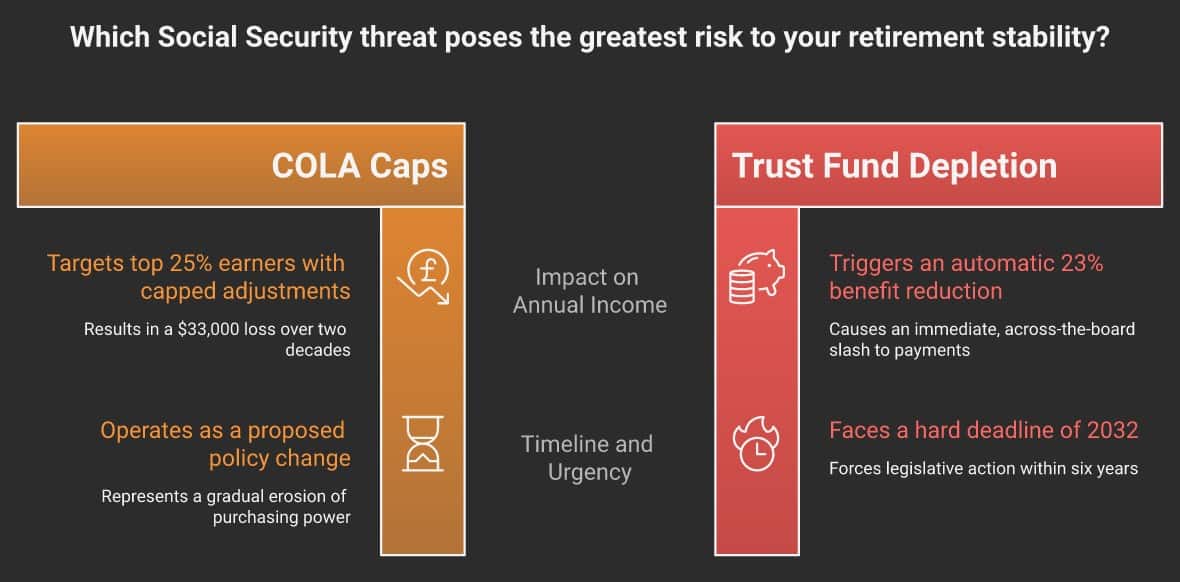
The CBO estimates that once the fund is exhausted, benefits would be cut 7% in 2032, then an average of 28% per year from 2033 to 2036. These aren’t hypothetical political threats — they’re arithmetic. If the money isn’t there, the money isn’t there.
Why You Need to Know This — From Someone Who’s Watched This Before
I’ve been helping people with money for over 30 years, and I’ll tell you what scares me about this moment: most people are only paying attention to one side of the squeeze.
If you’re only reading about the COLA cap, you’re thinking “that only affects high earners.” Maybe. But what’s a “high earner” today becomes a wider net tomorrow. That’s how every income-based policy works — the thresholds don’t keep up.
If you’re only reading about the trust fund, you’re thinking “Congress will fix it.” They might. But “fixing it” means some combination of benefit cuts, tax increases, and age changes. The fix itself will cost you something — the only question is what.
Here’s what nobody is saying clearly: even a “small” COLA reduction compounds devastatingly over a long retirement.
The compounding math: If your COLA is reduced by just 0.5% per year — from, say, 2.5% to 2.0% — on the average Social Security benefit of $23,712/year, you lose roughly $33,000 in cumulative benefits over a 20-year retirement. That’s not a rounding error. That’s a year and a half of income that quietly disappears from your plan.
And if you’re carrying debt into retirement — credit cards, a mortgage, a car payment — reduced Social Security plus persistent inflation is the exact combination that drives seniors into bankruptcy. I’ve watched this pattern accelerate during every economic squeeze for three decades. The people who get hurt worst are the ones who assumed their income would keep up with their fixed costs.
Listen: Steve and Damon discuss this topic in detail on the latest podcast episode — AI Layoffs, Student Loans, and Social Security.
The retirement debt trap: If your Social Security COLA doesn’t keep pace with inflation, your purchasing power shrinks every year — but your debt payments don’t. A credit card at 24% APR doesn’t care that your COLA was capped. This is why carrying debt into retirement on the assumption that Social Security will keep pace is one of the most dangerous financial assumptions you can make right now.
Things to Consider
Before you panic or tune out — both are natural reactions — consider where you actually stand. Not everyone needs to do the same thing here.
If You’re 10+ Years From Retirement
- You have time to adjust savings rates
- Paying off debt now protects you from the squeeze later
- Rethink the “delay to 70” advice everyone gives you. I took mine at 62, and the math supported it — when you invest the early checks, breakeven doesn’t arrive until your mid-80s, and one in three men who reach 62 don’t make it to 79. The conventional wisdom assumes you stuff checks under a mattress. Don’t plan your retirement on a longevity bet.
- Every dollar of debt you eliminate before retirement is a dollar that doesn’t need a COLA to cover it
If You’re Already on Social Security
- Check if you qualify for supplemental programs: SNAP, LIHEAP, property tax exemptions
- Do not take on new debt assuming benefits keep pace with inflation
- Review your fixed costs — which ones can you reduce or eliminate?
- If debt is overwhelming, know that bankruptcy protects Social Security income — it’s exempt from creditors
One thing that’s worth saying directly: “do nothing and monitor” is a legitimate strategy here if you’re already debt-free and living within your means. Not every headline requires action. But if you’re carrying debt into retirement, this headline requires honest math.
Free Tool — Benefits & Free Money Finder: There may be government programs, creditor hardship options, or nonprofit grants available to you. The free Benefits Finder personalizes results by state and situation — SNAP, Medicaid, LIHEAP, and more. Find Your Benefits →
What to Think About Doing Right Now
- Log into ssa.gov and pull your current benefit estimate. Know the actual number, not the one in your head from three years ago. If you’re already receiving benefits, look at your annual COLA history to understand how much your income has actually grown versus how much your costs have grown.
- Recalculate your retirement budget assuming benefits are 20% lower than projected. This isn’t pessimism — it’s what the CBO says will happen automatically if Congress doesn’t act. If that number doesn’t work, you have time to adjust. If it does work, you can stop worrying.
- If you’re carrying high-interest debt, pay it off before retirement. This is the single most protective move you can make against a COLA squeeze. A credit card payment that vanishes is better than a COLA increase that doesn’t come. The claiming timing matters, but the debt-free math matters more.
- Don’t blindly follow the “wait until 70” advice. Every financial advisor says delay for a bigger check — but I took mine at 62 and ran the real numbers. When you claim early and invest the difference at even 4%, breakeven doesn’t come until your mid-80s. SSA actuarial data shows one in three men who reach 62 die before 79. A dollar at 63 — when you can travel, be active, and get on the floor with your grandkids — is worth more than a dollar at 83. The SSA itself doesn’t recommend a specific claiming age because benefits are designed to be actuarially fair. Run your own numbers with your own health, savings, and plans. Just don’t trust AI chatbots to run this calculation for you.
- Talk to your family about this. If you have aging parents relying on Social Security, ask whether their fixed costs are covered if benefits don’t keep up. This isn’t a comfortable conversation, but it’s a necessary one — and it’s better to have it now than after the cuts happen.
Key Takeaway: Social Security is being squeezed from two directions — COLA caps for higher earners and a trust fund that runs out in 2032. The people most at risk are those carrying debt into retirement on the assumption their benefits will keep up with inflation. Log into ssa.gov, do the math at 20% less, and eliminate as much debt as possible before retirement. The best protection against a benefit squeeze is a lower cost of living.
Two more things from this week: Apple owes you up to $95 per iPhone from a new settlement (file the claim and put it toward debt), and the 25% EU tariff is quietly inflating your grocery and clothing bills by $100-250/month.
FAQ
Will Social Security COLA increases be eliminated?
No. The current proposal from the Committee for a Responsible Federal Budget would cap COLAs for higher-income retirees — not eliminate them. Retirees receiving less than $45,000/year would keep their full COLA. This is a proposal, not law.
When will Social Security run out of money?
The CBO projects the OASI trust fund will be depleted by 2032. This doesn’t mean Social Security disappears — it means the program can only pay out what it collects from payroll taxes, resulting in an estimated 23% across-the-board benefit cut unless Congress acts.
How much will Social Security benefits be cut if Congress does nothing?
The CBO estimates a 7% cut in 2032 when the trust fund is first depleted, followed by an average 28% cut per year from 2033 to 2036. These cuts would apply automatically to all beneficiaries regardless of income.
Is my Social Security protected if I file bankruptcy?
Yes. Social Security benefits are fully exempt from creditors in bankruptcy. Creditors cannot garnish your Social Security income, and filing bankruptcy does not affect your benefit amount. Federal Reserve research shows bankruptcy filers recover faster than those who don’t file.
Should I claim Social Security early because of the trust fund problem?
This is actually a more nuanced question than most advisors admit. The trust fund risk is real, but the conventional “always delay” advice has its own problems. I took mine at 62 — not out of fear, but because the math made sense for my situation. Claiming early gives you 5-8 years of checks that, when invested at even modest returns, create a head start that takes until your mid-80s to overcome. SSA data shows one in three men who reach 62 won’t make 79. The trust fund situation actually strengthens the case for claiming earlier: if benefits are cut proportionally, you’ve already collected years of full payments. Run the numbers for YOUR situation — health, savings, spouse, plans — not a generic calculator.
This is what I’m seeing after watching Social Security debates for three decades. The political promises change, but the math doesn’t. Whether benefits get capped, cut, or somehow fully funded, the safest position is always the same: lower your fixed costs, eliminate your debt, and don’t build a retirement plan that depends on Washington keeping every promise. That’s not cynicism — that’s 30 years of watching what actually happens. Take this as input for your planning, not a directive. You know your situation better than anyone. Nobody gets to tell you what to do with your money — not me, not anyone.
Dealing With Debt? Understanding your options is the first step. See how all your debt relief options compare — including ones most sites won’t tell you about. The Find Your Path quiz gives a recommendation based on your actual numbers, and the Scam-O-Meter checks any company’s complaint history before you sign. Federal Reserve research shows bankruptcy filers recover faster than those who don’t file.