Quick Answer: Most debt advice is structurally biased because every advisor — credit counselor, settlement company, or bankruptcy attorney — profits from recommending their own product, not the one best suited to your situation. Research from the American Economic Review, Federal Reserve, U.S. Senate, GAO, and peer-reviewed psychology journals shows this conflict of interest causes real harm: consumers in crisis — cognitively impaired by financial stress, and screening positive for depression at several times the normal rate — are steered away from the option with the best outcomes toward the option that generates fees. This is not a bad apple problem. It is how the industry is built.
Expert Context: I filed bankruptcy in 1990 after my real estate business collapsed, then founded a credit counseling organization and grew it to 70 employees — and eventually shut it down after seeing how the funding structure steers advice toward revenue-generating options rather than what’s best for the client. I have watched the debt relief industry from inside the organization, inside the bankruptcy filing office, and outside as an investigative writer for three decades. What the academic research confirms is what I lived.
I went bankrupt in 1990. After that, I founded a credit counseling organization and grew it to 70 employees. And then I shut it down because I saw what was happening to the people we were supposed to be helping.
Each weekday I send one short email: one money story that caught my attention, why it might matter to you, and one manageable thing you can do with it. A couple of minutes, and a dad joke.
In the latest issue (Oct 15): The ones who need the Social Security raise the most keep the least of it
Free. I sell nothing. Unsubscribe any time.
What I experienced from inside the industry — and what I have watched for three decades since — is now backed by research I could not have cited in 1994: congressional testimony, Federal Reserve economic studies, peer-reviewed psychology findings, and behavioral economics that explain, with clinical precision, why the system is broken.
The conclusion is not comfortable for anyone selling debt relief services, including the nonprofit kind. But it is what the evidence shows.
Three Reasons Debt Advice Fails You
The failure is not random. It follows three interlocking mechanisms that compound each other:
Each of these alone would be serious. Together, they create a system where the most vulnerable consumers — the ones who most need accurate information — are systematically steered toward the wrong choice.
The Conflict of Interest: Every Advisor Is Selling Something
There is no profession in consumer debt whose business model is to evaluate all options and recommend the best one for you. None.
- Credit counselors receive 6–15% of your monthly payments from creditors as “fair share” payments. Recommending bankruptcy eliminates that revenue stream.
- Debt settlement companies charge 15–25% of your enrolled or settled debt. Recommending bankruptcy generates nothing for them.
- Bankruptcy attorneys recommend bankruptcy — because that is what they do and what they are paid for.
The U.S. Senate Permanent Subcommittee on Investigations found in 2005 that this was not an edge case at a few bad agencies. The report documented that “some new entrants provided no bona fide education or counseling and placed every consumer onto a debt management program at unreasonable or exorbitant charges.”
What “Fair Share” Actually Means: Credit counseling agencies receive a percentage of every payment you make to creditors through a debt management plan. The agency’s revenue goes up the more you pay and the longer you stay enrolled. It goes to zero if you file bankruptcy. This is not a subtle conflict — it is a direct financial incentive to steer you into a multi-year program regardless of whether that program is right for your situation.
The American Bankruptcy Institute Journal is not a radical publication. It describes credit counseling services as “primarily creditor-sponsored agencies that perform functions that benefit creditors rather than acting as a neutral intermediary or debtor’s advocate.”
I ran one of these organizations. I saw this from inside. When I started in 1994, the intention was to help people. What I eventually saw was how the funding structure corrupts the intention — slowly, without anyone making a conscious choice to harm their clients. The incentives do it for you.
The debt relief industry is not organized around what is best for you. It is organized around what generates revenue from you. Those are not the same thing.— Steve Rhode
The Psychological Trap: You Cannot Think Straight
Here is the part the industry does not want you to understand: you are not making this decision at your best. You are making it at your worst.
Researchers at Warwick, Harvard, Princeton and the University of British Columbia published a landmark study in Science in 2013 showing that people already under financial pressure did measurably worse on reasoning tests in the moment, and that the gap eased once the money pressure did. The same person, with and without financial stress, performs measurably differently on intelligence and reasoning tests.
That cognitive impairment is happening at the exact moment you are supposed to evaluate your debt relief options, listen to a sales presentation, and make a consequential financial decision that will affect the next three to five years of your life.
The Myvesta Research Finding: In 2001, my organization Myvesta surveyed 136 debt counseling clients using the CES-D clinical instrument — the standard tool for measuring depression. We found that 49.3% of people seeking debt help screened positive for depression symptoms, with 39.7% in the severe range. For years I compared that to a 9.5% national figure and called it more than five times the rate. That comparison was wrong — it set a screening result against a diagnosis rate — and I have corrected it in full. The honest elevation is a range, roughly two to five times. The advice to “grind it out for five years” is being given to a population where half screen positive for depression — people who struggle neurologically with sustained motivation, future planning, and long-term goal pursuit.
And then there is shame. Financial shame is not just an uncomfortable feeling. It has documented behavioral consequences. A 2021 study in Organizational Behavior and Human Decision Processes found that shame — more than guilt — causes people to avoid financial information, disengage from their financial situation, and avoid seeking help. It creates what researchers call a “shame spiral”: shame leads to avoidance, avoidance leads to more debt, more debt leads to more shame.
A 2023 study in the Journal of Marketing Research found that people who anticipate being stigmatized for their debt engage in “concealment behaviors” — hiding their debt, social spending to appear normal, and actively avoiding professional help. The anticipation of judgment causes harm even when no actual judgment has occurred.
The debt relief industry is, at this point, in the business of approaching cognitively impaired, depressed, shame-spiraling consumers and offering them a solution. The problem is that the solution on offer is the one that generates fees — not necessarily the one that produces the best outcomes.
The Evidence Suppression: The Stigma Is Not Neutral
Bankruptcy stigma did not arise naturally. It was cultivated, sustained, and deployed as a sales tool.
The credit card industry spent more than $100 million lobbying for the 2005 Bankruptcy Abuse Prevention and Consumer Protection Act (BAPCPA). They promised that making bankruptcy harder would reduce creditor losses, and those savings would flow to consumers as lower interest rates.
Academic research found otherwise. Michael Simkovic’s 2009 study in the American Bankruptcy Law Journal documented that “although bankruptcies and credit card company losses decreased, and credit card companies achieved record profits, the cost to consumers of credit card debt actually increased. The 2005 bankruptcy reforms profited credit card companies at consumers’ expense.”
The word “Abuse” was embedded in federal law. The industry message — “bankruptcy is a last resort, for people who’ve failed” — became cultural common sense. Debt relief companies use that message actively: telling consumers that bankruptcy will destroy their credit for 10 years, cost them their jobs, and mark them as failures. That messaging, used to steer consumers away from the cheapest and legally clearest option, is documented in FTC enforcement records and GAO undercover investigations.
The Myth: “Bankruptcy will ruin your credit for 10 years and you’ll never recover.”
The Reality: A 2024 LendingTree analysis of actual bankruptcy filers found that average credit scores rose 69 points in the first month after filing. Filers with the worst credit (below 580) saw an average gain of 88.6 points. Dobbie, Goldsmith-Pinkham, and Yang (2017, Review of Economics and Statistics) studied 175,000+ bankruptcy filers and found that bankruptcy’s effect on employment prospects was a “precise zero” — no measurable impact on getting or keeping a job.
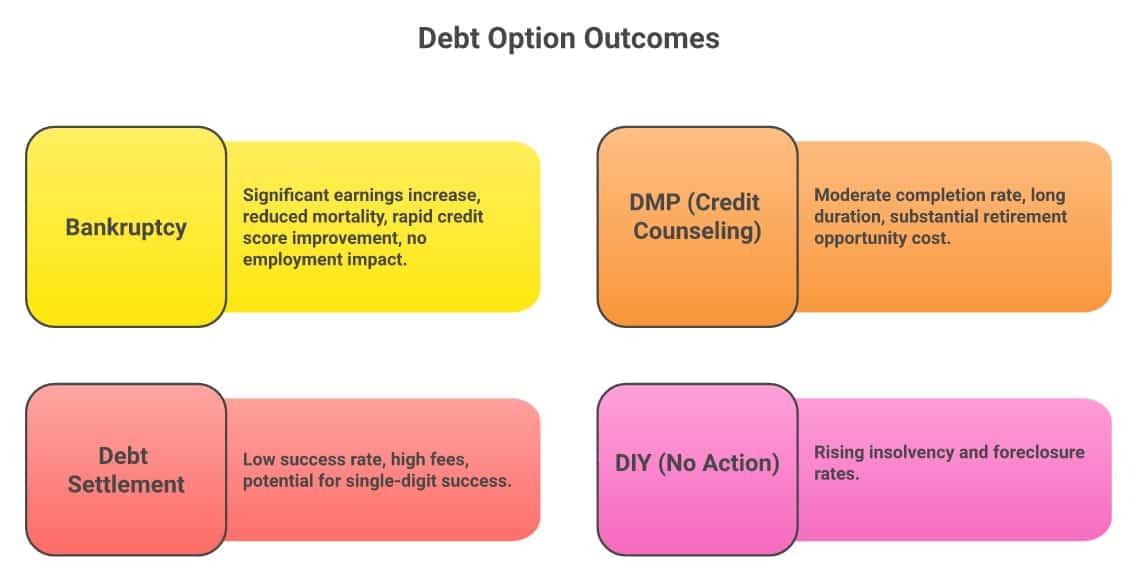
What the Outcome Research Actually Shows
Here is what happens when researchers stop listening to the industry’s claims and start measuring actual results.
Chapter 13 Bankruptcy
- Annual earnings increase: +$5,562 (Dobbie & Song, American Economic Review 2015)
- Five-year mortality decrease: 1.2 percentage points (same study)
- Foreclosure rate decrease: 19.1 points (same study)
- Credit score increase: +69 points in month one (LendingTree 2024)
- Employment effect: zero (Dobbie et al., RESTAT 2017)
- Debt Is the Symptom, Not the Problem: The Framework That Changes Everything About Getting Out of Debt
- Zombie Debt: A Collector Just Called About a 10-Year-Old Bill. Here’s What to Do (and Not Do).
- Gambling Destroyed Your Family’s Finances. Here’s the Two-Track Plan Nobody Tells You About.
Debt Management Plans (DMPs)
- Historical completion rate: 21–26% (NFCC data via Consumer Reports)
- Typical enrollment: 3–5 years
- Hidden cost: Lost retirement compounding (~$400K opportunity cost over a career)
- Requires sustained motivation for years — in a population where half screen positive for depression
- Fair share system: creditor-funded advice during enrollment
Debt Settlement
- Complete success rate (36 months): 23% (AFCC industry data)
- GAO-documented actual success: “often in the single digits”
- Fees: 15–25% of enrolled or settled debt
- Risk: Lawsuits and judgments during program
- Tax consequence: Forgiven debt is typically taxable as income
Debt Is the Symptom, Not the Problem: The Framework That Changes Everything
The foundational framework: five fires that create debt, why the industry treats the symptom, and how to find YOUR fire.
The Federal Reserve Bank of New York (Albanesi & Nosal, 2015) studied what happened to people who were pushed away from bankruptcy after BAPCPA raised barriers to filing. Their conclusion: “The decline in bankruptcy filings resulted in a rise in the rate and persistence of insolvency as well as an increase in the rate of foreclosure.” Being denied bankruptcy makes things worse. The alternatives to bankruptcy — struggling on without legal protection — produce the negative outcomes, not bankruptcy itself.
The Dobbie & Song Mortality Finding: Researchers used natural variation in bankruptcy judge leniency to identify the causal effect of bankruptcy protection (vs. dismissal). Receiving bankruptcy protection decreased five-year mortality by 1.2 percentage points compared to denied filers. The study’s note on direction matters: “These results come primarily from the deterioration of outcomes among dismissed filers, not gains by granted filers.” Bankruptcy does not make things better. Avoiding it makes things worse.
Free Tool — Statute of Limitations Checker: Dealing with old debt? The free Statute of Limitations Checker tells you if the collection clock has expired in your state — including the zombie debt and clock-restarting traps collectors use. Check My Status →
The Behavioral Economics of Wrong Choices
Behavioral economists have a name for what happens to decision-making under threat: threat rigidity. Staw, Sandelands, and Dutton (1981) documented that under stress, people constrict their information processing, consult fewer sources, and rely on the most familiar response — whatever worked before, whatever comes first.
In debt distress, “whatever comes first” is usually whoever called you. That caller has a conflict of interest. That caller is targeting a cognitively impaired, ashamed, and frightened person. And that caller is using documented fear appeals — “your wages will be garnished,” “creditors are about to sue you,” “bankruptcy will ruin your credit” — to trigger a rapid enrollment decision.
A 2019 study in Proceedings of the National Academy of Sciences (Ong, Theseira & Ng) found that having an additional debt account paid off improved cognitive function by about one-quarter of a standard deviation and reduced anxiety by 11%. This finding has a stark implication: quick debt resolution restores cognitive function. Multi-year debt management programs prolong cognitive impairment. The system recommending the longest path to resolution is also keeping the consumer in a state of diminished decision-making capacity for the longest time.
What I Want You to Know
I am not saying every credit counselor is dishonest. I am not saying every debt settlement company is a scam. I am saying the system is structured in a way that makes honest, unbiased, outcome-focused advice economically difficult to provide.
The person you talk to at a credit counseling agency may genuinely want to help you. But their employer’s revenue depends on you enrolling in a DMP. The person at a settlement company may believe in what they’re selling. But the fees their company collects are not aligned with your outcomes.
There is no neutral debt advisor at scale. That gap — the space where an independent fiduciary debt counselor would be — is filled by single-silo sellers.
Use the Free Tools: Before calling any debt relief company, use the free tools at GetOutOfDebt.org to understand your options. The Find Your Path tool can help you identify which debt options apply to your specific situation — without anyone’s sales commission attached to the answer. And if you’re not ready to call anyone yet, the Confidential Debt Confessional is anonymous and private — no account, no name required. Sometimes writing it out is the first step back toward action.
Math does not lie. The research does not lie. What the research shows is that consumers systematically underuse the option with the best outcomes — bankruptcy — because of a stigma that was manufactured by the industry that profits from the alternatives. And they make that underuse decision while cognitively impaired, screening positive for depression at several times the normal rate, and in the grip of shame that neuroscience shows activates the same brain circuits as physical pain.
This is what I want you to know before you make any decision about your debt. Not to steer you toward bankruptcy — it is not right for everyone. But to give you the full picture, because the industry does not.
Key Takeaways
- Every debt relief advisor profits from recommending their own product — there is no neutral fiduciary debt counselor at scale
- A 2013 Science study found money pressure measurably narrows reasoning in the moment — an effect the researchers put down to worry consuming mental bandwidth, which eased once the pressure lifted
- 49.3% of people seeking debt help screened positive for depression — a large elevation over the general population, honestly a range of roughly two to five times (Myvesta, 2001, n=136)
- Bankruptcy stigma was cultivated by the credit card industry through $100M+ in lobbying for BAPCPA (2005); the industry captured the savings as record profits, not passed them to consumers
- Research from the American Economic Review shows bankruptcy protection increases annual earnings by $5,562 and decreases five-year mortality by 1.2 percentage points vs. dismissed filers
- DMP historical completion rate: 21–26%. Debt settlement complete success rate: 23%. The alternatives to bankruptcy that are most heavily marketed have the lowest documented completion rates.
- Removing debt improves cognitive function by one-quarter standard deviation (PNAS, 2019) — quick resolution restores your ability to think
The Psychology of Debt Shame: What Neuroscience Shows
Financial loss activates the same brain circuits as physical pain. Debt shame was deliberately engineered by the collection industry. Here is the research on why shame makes debt outcomes worse.
How Bankruptcy Stigma Was Manufactured (And Who Profits)
The collection industry engineered debtor shame starting in 1946. The credit card industry spent $100M+ lobbying to embed it in federal law. Here is the documented history of who built the stigma and why.
Why People Make the Wrong Debt Decision: Behavioral Economics
Present bias, cognitive load, tunneling, threat rigidity, loss aversion — six documented psychological mechanisms explain why stressed consumers systematically choose the wrong debt relief option.
The Truth About Debt Settlement Success Rates
GAO undercover investigation: companies claimed 85-100% success rates. Government enforcement data showed rates ‘often in the single digits.’ Industry’s own AFCC reported 23% complete success at 36 months.
The Retirement Math Nobody Shows You Before a DMP
A 5-year DMP costs a 35-year-old approximately $247,000 in retirement savings. Chapter 7 discharges the same debt in 90 days. Your 401(k) is protected in bankruptcy anyway — by the Supreme Court.
AI Financial Advice Has a Problem: The Myths Baked Into Its Training Data
How AI financial advice tools absorbed cultural debt myths from training data — and repeat them with algorithmic confidence to millions.
LVNV Funding Bought Your Debt for Pennies on the Dollar
Federal data reveals what debt buyers pay for charged-off accounts — and why knowing the math changes your negotiating position entirely.
LVNV Funding Bought Your $10,000 Debt for $200
Federal data reveals what debt buyers pay for charged-off accounts — and why knowing the math changes your negotiating position entirely.
The Sandwich Generation Debt Crisis: $295,000 Lost
Urban Institute data reveals caregiving mothers lose $295,000 over a lifetime — and why every standard debt strategy fails this population.
Your Creditors Already Expected You Might Not Pay
Federal Reserve data proves creditors price your default into their profit model — and use moral framing as a proven collection strategy.
Related: On Disability With Debt? Here’s What Collectors Can’t Touch — and Why You May Not Need to Pay.
A Fired Debt Settlement Salesman Kept a Journal — It Shows Why That ‘Free Consultation’ Isn’t Financial Advice
A handwritten journal filed in a June 2026 federal lawsuit shows the daily reality of a debt settlement sales floor — quotas, autodialers, and managers pushing the close.
The Bottom Line
The debt relief industry has no neutral, fiduciary advisor — every provider profits from recommending their own product, not the one best suited to your situation. Congressional investigations, Federal Reserve studies, and peer-reviewed research confirm that consumers in financial distress are cognitively impaired by stress, screening positive for depression at several times the general population rate, and making decisions under shame that neuroscience shows activates the same brain circuits as physical pain. Bankruptcy — the option with the best-documented outcomes per American Economic Review research — is systematically undersold because it generates no revenue for any advisor with a financial stake in the conversation. The alternatives most heavily marketed have the lowest completion rates: DMPs at 21–26% historically, debt settlement at 23% best-case. Get a free bankruptcy consultation before enrolling in any program — not because bankruptcy is always right for you, but because the information costs nothing and gives you a complete picture before anyone with a financial incentive gets to you first.
Frequently Asked Questions
Is credit counseling a conflict of interest?
It depends on the agency and how it is funded. Credit counseling agencies that receive “fair share” payments from creditors — typically 6–15% of your monthly DMP payments — have a structural financial incentive to recommend DMPs over bankruptcy. The U.S. Senate investigated this practice in 2005 and found documented abuses. Not all agencies operate this way, but the structure creates a conflict that consumers should understand before enrolling.
Do debt settlement companies actually work?
Some do settle debts — but the success rates are far lower than marketing claims suggest. The AFCC (industry trade group) reported a 23% complete success rate at 36 months of enrollment. The GAO’s 2010 undercover investigation found companies claiming success rates “significantly higher than actual evidence” — with government agencies finding actual rates “often in the single digits.” If you do use a settlement company, compare their fee structure carefully and understand the tax consequences of forgiven debt.
Does bankruptcy really ruin your credit for 10 years?
The bankruptcy notation can appear on a credit report for 7–10 years, but “ruin your credit” is not what the data shows. LendingTree’s 2024 study found credit scores rose an average of 69 points in the first month after bankruptcy filing. Filers with the worst credit (below 580) gained an average of 88.6 points. A Federal Reserve-linked study (Dobbie et al., 2017) found zero measurable effect of bankruptcy on employment prospects. Credit rebuilds faster after a fresh start than during years of delinquency.
Why do financial advisors not recommend bankruptcy more?
Most financial advisors are not trained in debt resolution and are not licensed to give bankruptcy advice. Bankruptcy attorneys can recommend it, but their entire business is built around it — so they are not neutral either. Credit counselors and settlement companies have direct financial incentives to recommend their own services over bankruptcy. The result: the option with the best-documented outcomes (per American Economic Review research) is the one least often proactively mentioned by advisors with conflicts of interest.
How do I know which debt option is right for me?
The honest answer is that it depends on your specific situation — income, assets, types of debt, whether you own a home, and your state of residence all affect which option makes sense. What I can tell you is that you should get a free bankruptcy consultation before enrolling in any other program. A bankruptcy attorney can tell you in one consultation whether you qualify and what your options are. That information costs you nothing and gives you a complete picture before any other advisor — with a financial incentive to recommend something else — gets to you first.
Dealing With Debt? Understanding your options is the first step. See how all your debt relief options compare — including ones most sites won’t tell you about. The Find Your Path quiz gives a recommendation based on your actual numbers, and the Scam-O-Meter checks any company’s complaint history before you sign. Federal Reserve research shows bankruptcy filers recover faster than those who don’t file.