Quick Answer: High-income earners who develop gambling problems lose more than anyone else — not just in dollars gambled, but in lifetime wealth destroyed. A longitudinal study from Norway found that 61% of people diagnosed with gambling disorder followed income trajectories below the national average, with income gaps widening over time. Nearly half (45%) of bettors earning $150,000+ wager $500 or more per month. But the real cost isn’t what you lose at the table — it’s what that money would have been worth in retirement. $100,000 gambled away at age 35 costs you over $540,000 in lost retirement growth by age 60. Nobody in gambling recovery forums talks about this number.
Expert Context: At Myvesta, the credit counseling organization I founded in 1994, I created the first inpatient program for compulsive spending in the United States. Some of the highest-dollar cases I saw were professionals — attorneys, doctors, business owners — whose gambling had destroyed six-figure incomes. The conventional recovery world focuses on the addiction. The financial recovery world focuses on the debt. Nobody puts them together. That’s the gap this post fills.
If you earn good money and gambling has put you in debt, every piece of advice you’ll find online was written for someone else. The recovery forums assume you’re broke. The financial advisors assume you don’t have an addiction. You fall through both cracks. Here’s what I’ve learned about YOUR situation in 30 years.
About This Research
This analysis draws on a 2023 longitudinal study on income and gambling disorder from Norway (registry data, 2008-2018), UCLA research on sports betting legalization and bankruptcy, U.S. News 2025 Sports Betting and Debt Survey, the American Journal of Drug and Alcohol Abuse review of compulsive buying disorder, qualitative gambling research from the GOOD reference library, and 30 years of direct observation.
Each weekday I send one short email: one money story that caught my attention, why it might matter to you, and one manageable thing you can do with it. A couple of minutes, and a dad joke.
In the latest issue (Oct 15): The ones who need the Social Security raise the most keep the least of it
Free. I sell nothing. Unsubscribe any time.
Key Terms Defined
Gambling Disorder (GD): A recognized behavioral addiction in the DSM-5, characterized by persistent gambling that leads to clinically significant impairment. Not a lack of willpower — peer-reviewed research confirms it shares neurocircuitry with substance addiction.
Opportunity Cost: The retirement growth you lose when money is gambled instead of invested. At 7% average annual return, $100,000 lost at age 35 becomes $543,000 in lost retirement wealth by age 60. This is the number nobody in gambling recovery calculates.
High-Frequency Bettor: Someone who wagers regularly — daily or weekly — as opposed to occasional recreational gambling. The 2025 Sports Betting Survey found that high-frequency bettors are disproportionately high earners.
Why High Earners Lose More (Not Just More Dollars)
The conventional understanding of gambling debt is that it’s a poor person’s problem. The research tells a different story.
A 2022 study on gambling expenditure demographics found that among the population responsible for 50% of all gambling spending, 25.2% of that expenditure came from high-income individuals. Nearly half (45%) of bettors with household incomes of $150,000 or more wager $500+ per month.
Here’s what makes high earners different: they have access to more credit, more liquid assets, and more ability to hide the damage. A person earning $50,000 who loses $10,000 gambling can’t cover it — the crisis is immediate and visible. A person earning $150,000 who loses $50,000 can cover it with a HELOC, a 401(k) withdrawal, or a credit card with a $30,000 limit. The gambling continues because the consequences are delayed — until they’re catastrophic.
Common Belief: “People with good incomes can afford to gamble. If they get in trouble, they can earn their way out.”
The Research: A longitudinal study tracking income trajectories of people diagnosed with gambling disorder found that 61.4% followed income trajectories BELOW the national average over time — and the income gap WIDENED from 2012 onward. Gambling disorder doesn’t just consume current income. It destroys earning capacity. High earners don’t “earn their way out” — they earn their way deeper in.
The Retirement Math Nobody Calculates
This is the number that should terrify every high earner with a gambling problem — and it’s the number nobody in recovery forums ever mentions:
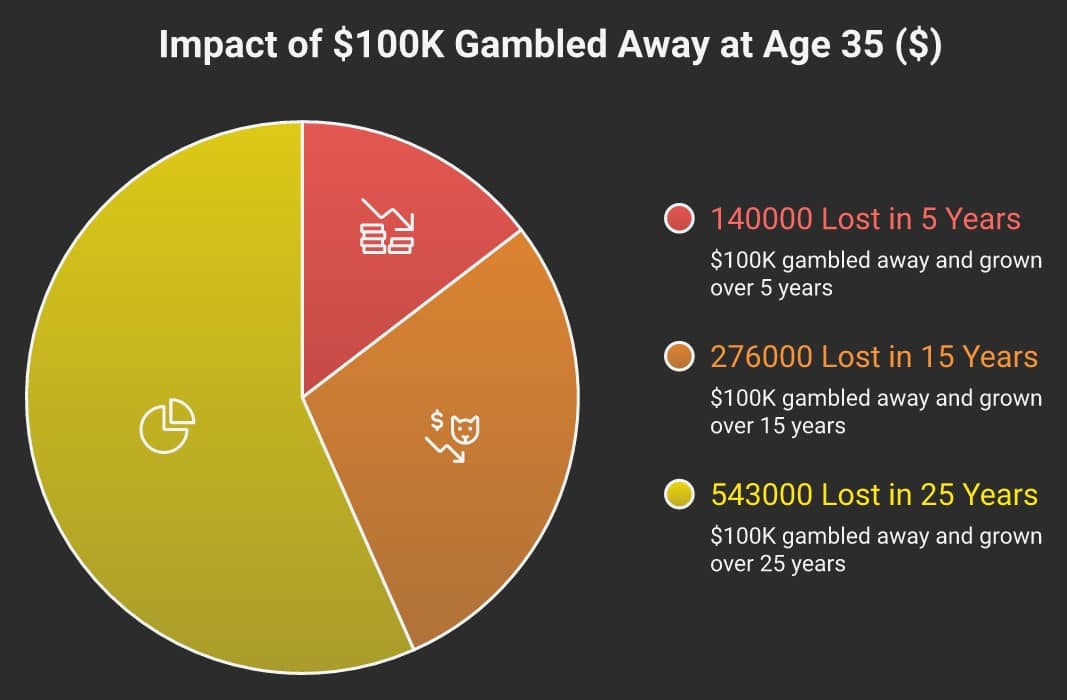
At a 7% average annual return — the historical stock market average — $100,000 that was gambled away at age 35 would have been worth $543,000 by age 60. You didn’t lose $100,000. You lost half a million dollars in retirement security.
And if you’re a high earner who was gambling $4,000 per month instead of investing it? Over 20 years, that’s $2.17 million in lost compound growth. Not $960,000 in total bets — $2.17 million in what that money would have become.
I’ve said it a thousand times: never cash out retirement to pay unsecured debt. But gambling does something worse than cashing out — it prevents the retirement from ever being built in the first place. The money never makes it to the account. It vanishes before compound growth can touch it.
Gambling doesn’t just cost you what you lose. It costs you what that money would have become. A high earner gambling away $4,000 a month is burning $2.17 million in retirement over 20 years — and nobody in recovery is doing that math.— Steve Rhode
The Sports Betting Accelerant
The explosion of legal mobile sports betting has changed the landscape dramatically — and high earners are the prime targets.
Americans bet nearly $150 billion on sports in 2024. A 2025 U.S. News survey found that 30% of sports bettors now carry debt from gambling. Among those with gambling-related debt, 51% owe $500 or more, 12% have taken out payday loans to fund bets, and 25% have missed bill payments.
UCLA research analyzing 4 million people across 38 states found that states permitting online sports betting saw substantial increases in auto loan delinquencies, bankruptcies, and debt collections. Credit scores declined at three times the rate in mobile betting states compared to in-person-only states.
For high earners, sports betting is especially dangerous because it looks like skill. Unlike casino gambling — where the randomness is obvious — sports betting feels like analysis. You watch the games. You read the stats. You convince yourself you have an edge. The apps are designed to reinforce this illusion. And because you earn enough to absorb losses for months or years, the feedback loop that would stop a lower earner doesn’t apply to you until the damage is already massive.
Warning: If you’re earning good money and betting on sports “recreationally” but can’t name your total losses over the past 12 months — you may not have a gambling problem yet, but you have a financial blindspot. Check your bank and credit card statements. Add up every deposit to DraftKings, FanDuel, BetMGM, or any betting app. The number will likely surprise you.
Debt Is the Symptom. The Gambling Is the Fire.
This is where my framework — “debt is the symptom, not the problem” — applies most directly. The debt from gambling is charred wood. The gambling itself is the fire. And the gambling is usually a symptom of something even deeper — stress, relationship problems, the dopamine hit that work no longer provides, or a brain that’s wired for risk in a way that served you in business but destroys you at the sportsbook.
Our Myvesta research screened 136 debt-crisis clients with the CES-D, and 49.3% screened positive for depression symptoms — a screen, not a diagnosis. Among gamblers, the comorbidity is even higher. Clinical research shows that 21-100% of compulsive gamblers have comorbid mood disorders. You’re not just fighting a gambling problem — you’re fighting whatever drove you to gambling in the first place.
For the research on how spending operates on the same brain circuitry as substance addiction — and what actually works to break the cycle — read my deep dive on spending addiction and what the research says actually works.
What to Do About the Debt — High Earner Edition
Your options are different from a low earner’s. Not better — different. And some of them will surprise you.
Bankruptcy (Yes, Even for High Earners)
This is the option nobody tells you about because you “make too much money.” But Chapter 7 has income tests that are more nuanced than people think, and Chapter 13 allows structured repayment while protecting your assets. Federal Reserve research shows filers recover within 2-3 years. I filed in 1990. Your income rebuilds fast — your credit recovers faster than you think. The gambling debt doesn’t have to follow you.
Address the Gambling First
Eliminating the debt without treating the gambling puts you right back here. The National Council on Problem Gambling helpline (1-800-522-4700) is free, confidential, and available 24/7. Gamblers Anonymous exists specifically for this. And yes, high earners attend — you’re not the only successful person there.
Protect Your Retirement Immediately
If you haven’t already raided your 401(k) or IRA to cover gambling losses — stop. Retirement accounts are protected in bankruptcy. They compound. Every dollar that stays in retirement is worth $3-5 in 20 years. The gambling debt is unsecured — it can be discharged. The retirement money cannot be replaced.
Self-Exclusion From Betting Apps
Every legal sports betting state offers self-exclusion programs. You can ban yourself from DraftKings, FanDuel, and all licensed operators in your state. It’s free and it’s private. Do it today. You can’t fight the addiction while the apps are still on your phone.
Not sure which debt option fits? Take the Find Your Path quiz — it accounts for income, assets, and debt type. High earners have options that lower earners don’t, but the quiz shows you which ones apply to YOUR specific numbers.
Need to talk this through privately? Ask Steve directly — describe your situation and I’ll help you think through your options. No judgment. I’ve seen this hundreds of times.
Key Takeaways
- 45% of earners above $150K bet $500+/month — high income doesn’t protect you, it enables larger losses
- $100,000 gambled away at 35 costs $543,000 in lost retirement by 60 — the real cost is compound growth, not the bet
- 61.4% of people with gambling disorder see income trajectories fall BELOW average over time — you can’t earn your way out
- States with mobile sports betting see increased bankruptcies, delinquencies, and credit score declines (UCLA, 4M people studied)
- Gambling debt is dischargeable in bankruptcy — retirement savings are not. Protect retirement first.
- The gambling is the fire. The debt is the charred wood. Address both — but find the fire first.
Related: If gambling put you in debt, see How to Make 900% on Your Money in 90 Days — why Chapter 7 bankruptcy delivers a 900% ROI compared to trying to trade your way out.
The Bottom Line
If you’re reading this because you earn good money and gambling has put you in a hole you can’t explain to anyone — I want you to know: you’re not the first successful person this has happened to. I’ve seen attorneys, doctors, business owners, and engineers in this exact position. The income that should have been your safety net became your enabling mechanism — more credit, more access, more ability to hide the damage until it was catastrophic. But here’s what 30 years has taught me: the fact that you earn well is actually your greatest recovery asset. Your income rebuilds fast. Your credit recovers. Federal Reserve data proves bankruptcy filers are better off within 2-3 years. What you can’t recover is the retirement compound growth that’s already gone — which is exactly why stopping NOW matters more for you than for anyone else. Call the National Council on Problem Gambling (1-800-522-4700) today. Take the Find Your Path quiz to see your debt options. And know this: the gambling didn’t define you. What you do next does.
Frequently Asked Questions
Can high earners file for bankruptcy over gambling debt?
Yes. Gambling debt is unsecured debt dischargeable in bankruptcy. Chapter 7 has income tests (the “means test”), but many high earners qualify — especially if their income has dropped due to the gambling’s impact. Chapter 13 is available regardless of income and allows structured repayment while protecting assets. Consult a bankruptcy attorney — Federal Reserve research shows filers recover financially within 2-3 years.
How do I calculate how much gambling has actually cost me?
Pull 12 months of bank and credit card statements. Search for every deposit to betting apps (DraftKings, FanDuel, BetMGM, etc.), every casino withdrawal, every Venmo to a bookie. Add the total. Then multiply by the number of years you’ve been gambling regularly. The withdrawal total minus any documented wins is your net loss. Then add the compound growth that money would have earned — at 7% annually, multiply your total losses by 1.4 (5 years) to 5.4 (25 years) to see the real retirement cost.
Is sports betting addiction different from casino gambling addiction?
The brain chemistry is the same — dopamine, anticipation, loss-chasing. But sports betting feels different because it mimics skill-based activity. You analyze matchups, read injury reports, track odds. This illusion of control makes it harder to recognize as addiction. The UCLA research found that mobile sports betting states see substantially worse financial outcomes than in-person-only states — because the phone makes it frictionless.
Will my employer find out if I file bankruptcy?
Bankruptcy is a public record, but employers don’t typically search for it — and federal law prohibits discrimination against employees solely for filing bankruptcy (11 U.S.C. § 525). If you hold a security clearance or professional license, consult an attorney about specific implications. In most cases, the bigger career risk is the gambling debt itself — wage garnishments, lawsuits, and financial instability are far more visible to employers than a bankruptcy filing.
Free Tool — Wage Garnishment Calculator: Worried about your paycheck being seized? The free Wage Garnishment Calculator shows exactly how much creditors can legally take in your state — and some states prohibit garnishment entirely. Calculate My Risk →
How do I stop when I can afford to keep going?
This is the core trap for high earners. You can absorb the losses — until you can’t. The answer isn’t willpower. It’s structural: self-exclude from every betting app in your state (every state has a program), give a trusted person access to monitor your accounts, and call the National Council on Problem Gambling helpline (1-800-522-4700). Also take the Debt Stress Test — it uses the same screening tool doctors use for depression, and the link between gambling debt and depression is well-documented.
Part of a Research Series: This post is part of Why Financial Education Fails: The Research on Money Psychology and Behavior — a complete collection of research on financial education, money psychology, and debt behavior research.
Sources and Methodology
This post draws on the following primary sources:
- Sundqvist, K. et al. — “Income and Gambling Disorder: A Longitudinal Matched Case-Control Study” (2023), Journal of Gambling Studies — 61.4% of GD patients below average income trajectories, income gaps widening over time
- Salonen, A.H. et al. — “Socio-Demographic Factors, Gambling Behaviour, and the Level of Gambling Expenditure” (2022), Journal of Gambling Studies — 25.2% of top gambling expenditure from high-income individuals
- Hollenbeck, B. — “Financial Consequences of Legalized Sports Gambling” (2024), UCLA Anderson Working Paper — 4 million people studied; increased bankruptcies, delinquencies, and credit score declines in mobile betting states
- U.S. News — “2025 Sports Betting and Debt Survey” — 30% of bettors carry gambling debt; 45% of $150K+ earners bet $500+/month
- Black, D.W. — “A Review of Compulsive Buying Disorder” (2007), American Journal of Drug and Alcohol Abuse — Shared neurocircuitry with substance addiction; 21-100% mood disorder comorbidity
- Federal Reserve Bank of New York — “Insolvency After the 2005 Bankruptcy Reform” (2015) — Bankruptcy filers recover financially within 2-3 years
- Cassidy, R. et al. — Qualitative Research in Gambling (2013) — Qualitative accounts of gambling’s cascade through social networks and family relationships (GOOD reference library)
- Rhode, S. — Myvesta Foundation (1994-2006) — First inpatient program for compulsive spending; direct observation of high-earner gambling cases
Dealing With Debt? Understanding your options is the first step. See how all your debt relief options compare — including ones most sites won’t tell you about. The Find Your Path quiz gives a recommendation based on your actual numbers, and the Scam-O-Meter checks any company’s complaint history before you sign. Federal Reserve research shows bankruptcy filers recover faster than those who don’t file.