
Quick Answer: Financial infidelity — hiding debt, secret spending, or concealed accounts from your partner — affects roughly 40% of American couples, and a 2012 study using data from 4,574 couples found that financial disagreements are the single strongest predictor of divorce, outranking conflicts about children, sex, or in-laws. I coined the term “sexually transmitted debt” because one partner’s hidden debt literally becomes the other’s problem through shared finances, joint liability, and community property laws. After 12 years of running a credit counseling organization, I can tell you: financial infidelity was the number one presenting issue that walked through our doors. Not credit card balances. Not medical bills. Hidden debt that a partner didn’t know about.
Expert Context: I ran Myvesta Foundation (formerly Debt Counselors of America) from 1994 to 2006 — a nonprofit credit counseling organization with 70 employees. I personally filed bankruptcy in 1990 and rebuilt from zero. From inside that organization, I saw thousands of couples where the real crisis wasn’t the debt itself — it was the secret. I coined “sexually transmitted debt” to describe how one partner’s hidden financial behavior infects the other’s credit, savings, and future. The academic research now confirms what I watched happen in real time for over a decade.
Your partner has been hiding debt from you. Or maybe you’re the one hiding it. Either way, you already know something is wrong — you just didn’t have a name for it. The name is financial infidelity, and the research shows it’s more common, more damaging, and more recoverable than you think.
About This Research
This analysis draws on peer-reviewed research from the Journal of Consumer Research (Notre Dame, 2020), the Journal of Interactive Marketing (2025), and Family Relations (Kansas State University, 2012), along with survey data from Bankrate/YouGov (2025, n=2,564), Debt.com (2025), the American Institute of CPAs, and Experian (2024). All statistics are linked to their original sources below.
Each weekday I send one short email: one money story that caught my attention, why it might matter to you, and one manageable thing you can do with it. A couple of minutes, and a dad joke.
In the latest issue (Oct 15): The ones who need the Social Security raise the most keep the least of it
Free. I sell nothing. Unsubscribe any time.
Key Terms Defined
Financial infidelity: Engaging in any financial behavior expected to be disapproved of by your romantic partner and intentionally failing to disclose it. This definition comes from a 2020 peer-reviewed study in the Journal of Consumer Research that developed the first academic measurement scale for this behavior.
Sexually transmitted debt: A term I coined describing how one partner’s hidden debt literally transfers to the other through joint accounts, authorized user status, community property laws, and shared financial obligations. It’s not a metaphor — it’s a legal and financial reality.
Financial infidelity asymmetry: The mismatch between partners’ tendencies toward financial secrecy. A 2025 study in the Journal of Interactive Marketing found that it’s this asymmetry — not financial infidelity itself — that most strongly predicts poor outcomes for the couple.
What the Research Actually Shows About Financial Infidelity
Financial infidelity is not a fringe behavior. It is the norm in American relationships, and the data is getting worse, not better.
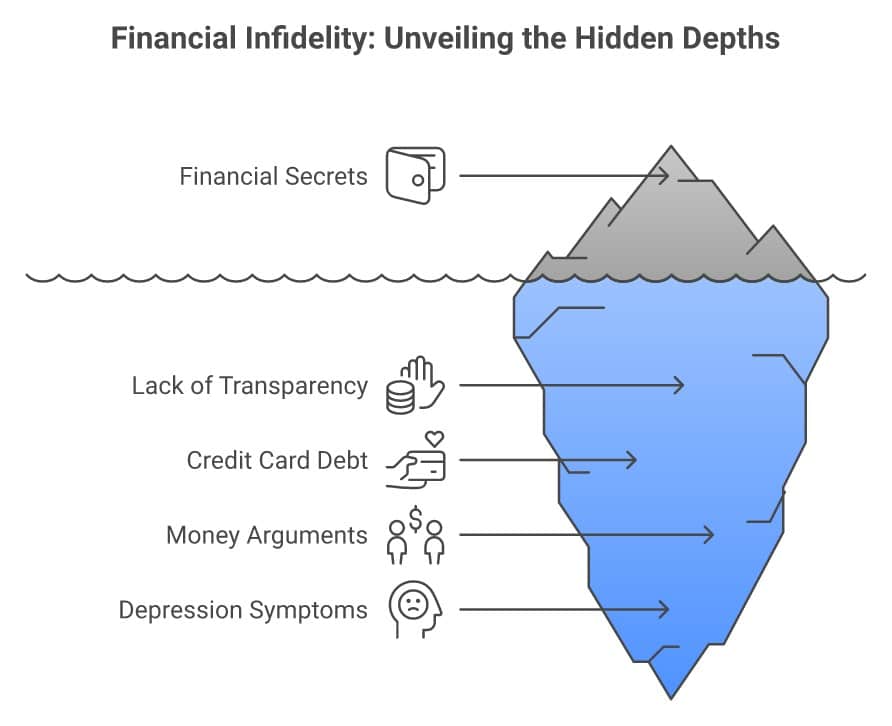
A December 2025 Bankrate/YouGov survey of 2,564 adults found that 45% of Americans in committed relationships admit they don’t know everything about their partner’s finances. Among those keeping secrets, 9% are concealing what they themselves describe as major sources of debt, expenses, or income. Another 25% are keeping “minor” secrets — which, in my experience running a credit counseling organization, often turn out to be not minor at all.
The generational data is striking. Only 44% of Gen Z adults in relationships say they know everything about their partner’s finances, compared to 64% of baby boomers. That’s not because younger people are more dishonest — it’s because they’re more likely to keep finances separate, which means less visibility into what’s happening on the other side.
A 2025 Debt.com survey found that 42% of divorced couples said credit card debt played a role in ending their marriage — up from 34% in 2024 and 29% just two years before that. More than a third of divorced respondents admitted to hiding debt from their spouse.
The Daily Money Brief — Free, at 10 AM
Money you may be owed, scams to dodge, and the fine print decoded — the consumer money news that affects your wallet, every weekday.
In 2020, researchers from Notre Dame, University College London, Boston College, and Indiana University published the first peer-reviewed study to formally define and measure financial infidelity. Their research in the Journal of Consumer Research used 10 lab studies, a field study, and real bank account data to develop the Financial Infidelity Scale. They found that financial infidelity is a measurable personality trait — some people are consistently more prone to financial secrecy than others — and that it predicts specific behaviors: spending despite anticipated spousal disapproval, preferences for discreet payment methods, and concealing bank account information.
Common Claim: “Financial infidelity is just about dishonest people who can’t control their spending.”
What the Research Shows: A 2025 study using real bank account data from a money management app found that it’s not individual financial infidelity that predicts the worst outcomes — it’s the asymmetry between partners. When one partner is transparent and the other is secretive, the couple develops individualized rather than shared financial goals, which predicts lower financial and relationship well-being. The problem isn’t one person’s dishonesty. It’s two people operating in different financial realities.
The Shame-to-Hiding Pipeline: What I Saw From Inside a Credit Counseling Organization
Most financial advice about hidden debt treats it as a trust problem. Fix the trust, fix the marriage. That framing misses the mechanism entirely.
From 1994 to 2006, I ran a credit counseling organization with 70 employees. We helped thousands of people work through debt crises. And here is what I can tell you from the inside: the vast majority of people who hid debt from their partners were not dishonest people. They were ashamed people.
The cycle works like this. Someone overspends or takes on debt they didn’t plan for — a medical bill, a job loss, a spending episode driven by depression or anxiety. They feel ashamed. They hide it. The hiding creates a financial blind spot. The blind spot allows the debt to grow. The growing debt deepens the shame. The deeper shame makes disclosure feel impossible. And the cycle accelerates until something breaks — a collections call, a declined mortgage application, a credit report pulled during a refinance. And if the overspending crossed into accounts opened in YOUR name without your knowledge, that’s identity theft — my crisis guide on accounts opened in your name covers the federal tools that clear it.
When I ran the Myvesta Foundation, we screened 136 debt clients with the CES-D and 49% screened positive for depression symptoms — an elevation over the general population that I now state as a range of roughly two to five times, after correcting a comparison I had wrong for years. That’s not a coincidence. Debt causes depression, and depression makes financial management harder, which creates more debt, which deepens the depression. The hiding partner isn’t just keeping a secret — they may be clinically impaired in their ability to manage the situation at all.
Free tool: If debt stress is affecting you or your partner, take the Debt Stress Test — a free, private screening based on the same clinical indicators we used at Myvesta. It takes two minutes and nobody sees the results but you.
Debt is math wrapped in emotion. Financial infidelity is what happens when the emotion wins and the math goes underground.— Steve Rhode
I also observed something the research hasn’t fully captured yet: savers attract spenders. Opposites attract in relationships, but that dynamic creates a built-in pressure toward financial secrecy. The spender knows the saver will judge. The judgment reinforces the shame. The shame drives more hiding. And the hiding destroys the trust that the relationship needs to survive.
Signs Your Partner May Be Hiding Debt
After watching thousands of these situations unfold, here are the patterns I saw most often. None of these is proof by itself, but several together should start a conversation.
- Mail interception: Your partner grabs the mail first every day, or has switched everything to paperless and gets anxious about shared email access
- Vague answers about money: Questions about finances are deflected, met with anger, or answered with “it’s fine” without specifics
- Unexplained purchases or lifestyle gaps: New items appear without explanation, or income doesn’t match the household’s spending reality
- Resistance to combining finances or sharing logins: Adamant refusal to allow any visibility into their accounts — not normal privacy boundaries, but defensive walls
- Cash withdrawals that don’t match spending: Regular ATM withdrawals that are higher than what’s showing up in household expenses
- New credit cards you didn’t know about: You find statements or get pre-approved offers for cards in their name you’ve never seen
- Collections calls they dismiss: Phone calls they take in another room, explained away as spam or wrong numbers
- Avoidance of financial conversations: Bringing up a budget, savings goal, or mortgage refinance triggers an outsized emotional reaction
Important distinction: Financial infidelity is about concealment and deception. Financial privacy is about maintaining reasonable personal autonomy. Having your own checking account isn’t financial infidelity. Having a secret checking account with $30,000 in debt your partner doesn’t know about is. The line is secrecy that, if discovered, would materially change your partner’s financial decisions or security.
The Conversation That Saves the Marriage — or Protects You if It Doesn’t
Whether you’re the one hiding debt or the one who just discovered it, the next conversation is the most important financial discussion of your relationship. Here’s what I’ve seen work, and what I’ve seen make things worse.
If You’ve Been Hiding Debt
- Choose a calm moment. Not during a fight, not when your partner is stressed about something else, not at the end of a long day
- Lead with accountability, not excuses. “I’ve been hiding debt from you. The total is [amount]. I should have told you sooner.” Full stop. Don’t explain why before they’ve had time to process the fact
- Bring the full picture. Half-disclosures are worse than the original secret. If you say $15,000 and they find out it’s $40,000, you’ve now committed financial infidelity twice
- Come with a proposed plan. Not a finished plan — a starting point. Show that you’ve thought about how to address it, and that you want to figure it out together
- Don’t minimize. “It’s not that much” or “everyone has some debt” will feel like gaslighting to your partner
- Don’t blame them. “I hid it because you’d freak out” makes the concealment their fault. Own it completely
- Don’t promise it will never happen again without a structural change. Willpower doesn’t prevent financial infidelity. Transparency systems do
If You’ve Just Discovered Hidden Debt
- Take time before making permanent decisions. The anger and betrayal are real. But decisions made in the first 48 hours are almost always worse than decisions made a week later
- Ask for the full accounting. Pull both credit reports. Ask for every account, every balance, every minimum payment. If they won’t provide it, that tells you something too
- Separate the debt from the person. Your partner may have a spending problem, a gambling problem, a depression-driven coping mechanism, or simply poor financial literacy. Understanding the root cause matters for what comes next
- Protect your own finances immediately. Freeze your credit. Check for any accounts opened in your name. Understand what debt you’re legally responsible for in your state
Common Claim: “Couples should combine all finances to prevent financial infidelity.”
What the Research Shows: The 2025 financial infidelity asymmetry study found that it’s shared financial goals — not shared accounts — that protect couples. Partners who set joint financial goals together had better outcomes regardless of account structure. Forced financial merging without shared goals just creates a new venue for conflict. The Bankrate survey found that 28% of people who keep financial secrets say they should be allowed to keep some information to themselves — and they may be right, as long as the secrets don’t cross the line from privacy into deception.
How to Protect Yourself From Sexually Transmitted Debt
I coined the term “sexually transmitted debt” because the transmission mechanism is real. Your partner’s hidden debt can become your problem through several legal and financial pathways. Here’s how to protect yourself.
Monitor Your Credit
Pull your credit report at AnnualCreditReport.com regularly. Look for accounts you don’t recognize, inquiries you didn’t authorize, or authorized user status on cards you didn’t agree to.
Understand Your State’s Debt Laws
In community property states (Arizona, California, Idaho, Louisiana, Nevada, New Mexico, Texas, Washington, Wisconsin), debt acquired during marriage may be considered joint regardless of whose name it’s in. Know your state’s rules before you need them.
Review Joint Accounts Monthly
If you have joint credit cards or lines of credit, both partners should review statements monthly. The partner who “handles the finances” should not be the only one seeing the numbers.
Schedule Financial Check-Ins
A monthly 30-minute conversation about money — income, expenses, debts, goals — makes financial infidelity harder to sustain. Make it a calendar appointment, not an ambush.
Keep Your Name on Major Assets
Ensure your name is on the house title, vehicle titles, and major financial accounts. Being removed from these without your knowledge is a form of financial abuse that goes beyond infidelity.
Maintain Some Financial Independence
Having your own account with enough to cover a few months of expenses isn’t distrust — it’s basic risk management. This is especially important if your partner has a history of financial secrecy.
When the Debt Is the Symptom: Addressing What Broke the Math
Debt is what is left over when the math is broken. Financial infidelity is what happens when someone tries to hide the broken math instead of fixing it. If your relationship is facing this crisis, the path forward depends entirely on what broke the math in the first place.
Common Root Causes I Saw in Credit Counseling
Depression or anxiety: Spending as a coping mechanism, followed by shame-driven concealment. This was the most common pattern. A therapist, not a financial advisor, is the first call.
Income loss: A job loss or pay cut that the person was too ashamed to disclose, masked with credit cards. Common and recoverable once disclosed.
Gambling: A separate addiction that requires specialized treatment. Financial plans built without addressing the gambling will fail.
Financial illiteracy: Genuinely not understanding how compound interest, minimum payments, or credit utilization works. Fixable with education.
Control and abuse: Using money to maintain power in the relationship. This is not financial infidelity — it’s financial abuse, and requires safety planning before financial planning.
Most financial advice sites will tell you to create a repayment plan together, consolidate the debt, and rebuild trust over time. That advice isn’t wrong. But it’s incomplete, because it ignores the math.
If the hidden debt is $50,000 in credit cards at 24% interest, a traditional repayment approach could take 5-7 years and cost $30,000 or more in interest alone. A debt management plan through credit counseling might reduce the rate, but you’re still looking at 4-5 years of reduced payments while retirement contributions stop. I ran a credit counseling organization — I know the math on this personally. The opportunity cost of those lost retirement contributions, compounded over 20-30 years, can exceed $400,000.
This is where most advice stops. Here’s where mine diverges.
For many couples, especially those with unsecured debt that dwarfs their ability to repay within 2-3 years, Chapter 7 bankruptcy may be the fastest path not just out of debt, but out of the shame cycle that caused the financial infidelity in the first place. Research shows that bankruptcy filers recover financially faster than non-filers in comparable situations. Retirement assets are protected. And the average credit score after a Chapter 7 filing begins recovering within 12-18 months.
I’m not saying every couple dealing with financial infidelity should file bankruptcy. I’m saying it should be on the table as an option, evaluated without shame, and compared honestly to the alternatives. The conversation about hidden debt should include all available paths — not just the ones that take the longest and cost the most.
Not sure where to start? Take the Find Your Path quiz to get guidance specific to your situation, or ask me directly through Ask Steve.
Key Takeaways
- Financial infidelity affects roughly 40% of American couples, and the rate is increasing — the percentage of divorcees citing credit card debt rose from 29% to 42% in just two years
- Money arguments are the #1 predictor of divorce according to a study of 4,574 couples — regardless of income, net worth, or debt level
- It’s the asymmetry between partners (one transparent, one secretive) that predicts the worst outcomes, not the secrecy itself
- Financial infidelity is almost always driven by shame, not dishonesty — 49% of debt clients in the credit counseling organization I ran screened positive for depression symptoms
- Protection starts with visibility: monthly credit checks, shared financial goals (not necessarily shared accounts), and scheduled money conversations
- When the hidden debt is large, evaluate all options including bankruptcy — not just the repayment plans that extend the suffering for years
The Bottom Line
Financial infidelity is not a character flaw. It is the predictable result of a culture that treats debt as a moral failure, creating shame that drives concealment. A 2025 Bankrate survey found that 43% of Americans consider financial secrets as damaging as physical infidelity, and a longitudinal study of 4,574 couples at Kansas State University found that financial disagreements are the strongest predictor of divorce — stronger than conflicts about children, sex, or in-laws, regardless of income level. After running a credit counseling organization for 12 years, I can tell you: the couples who survived financial infidelity were not the ones who ground through a 5-year repayment plan in silence. They were the ones who named the shame, got complete transparency on the numbers, and chose the fastest legal path to eliminate the debt — including bankruptcy when the math demanded it. Your partner’s hidden debt is a crisis. But it is a solvable crisis, and the solution starts with a conversation, not a spreadsheet.
Frequently Asked Questions
Is financial infidelity grounds for divorce?
A 2025 Debt.com survey found that more than one-third of divorced respondents believe hidden debt should justify divorce. Legally, financial infidelity can be relevant in divorce proceedings — particularly regarding asset division and debt responsibility. But in my experience, the question isn’t whether hidden debt justifies divorce. The question is whether your partner is willing to be fully transparent going forward and address whatever caused the hiding. If yes, the relationship can recover. If they minimize, deflect, or disclose in stages, that tells you the pattern isn’t changing.
Am I responsible for my spouse’s hidden debt?
It depends on your state. In community property states (Arizona, California, Idaho, Louisiana, Nevada, New Mexico, Texas, Washington, and Wisconsin), debt incurred during the marriage may be considered joint debt regardless of whose name it’s on. In common law states, you’re generally only responsible for debt in your name or on joint accounts. However, if your spouse opened accounts using your information without your knowledge, that’s identity theft and should be reported. Talk to a family law attorney in your state for specifics.
How common is financial infidelity really?
Extremely common. The 2025 Bankrate/YouGov survey found that 45% of Americans in committed relationships don’t know everything about their partner’s finances, and 9% are actively hiding major financial information. Earlier Bankrate surveys found that 42% of adults have kept at least one financial secret from a partner. Among younger adults, the numbers are higher — 67% of Gen Z respondents reported keeping financial secrets. The 2020 Journal of Consumer Research study from Notre Dame found that financial infidelity is a measurable personality trait with consistent behavioral predictors, suggesting it’s a stable pattern, not a one-time lapse.
Can a relationship recover from financial infidelity?
Yes, but not through willpower alone. Recovery requires three things: full financial disclosure with no exceptions, identifying and addressing the root cause (depression, addiction, financial illiteracy, or relationship power dynamics), and building structural transparency (shared access to accounts, scheduled financial conversations, credit monitoring). The couples I saw recover were the ones who treated it as a systems problem, not a character problem. The ones who didn’t recover were those where the disclosure came in stages — $10,000 became $25,000, which became $60,000 — destroying trust further with each revelation.
What’s the difference between financial infidelity and financial abuse?
Financial infidelity is concealment — hiding debt, secret spending, undisclosed accounts. Financial abuse is control — restricting a partner’s access to money, preventing them from working, running up debt in their name without consent, or using money as a tool of coercion. They can overlap, but they require different responses. Financial infidelity can be addressed through transparency and communication. Financial abuse requires safety planning and often legal intervention. If your partner is controlling your access to money, preventing you from seeing accounts, or threatening you over finances, contact the National Domestic Violence Hotline at 1-800-799-7233.
Part of the Debt & Marriage Hub: This post is one piece of my complete Debt and Marriage Guide — research on financial infidelity, hidden debt, the conversations that save marriages, and recovery options most advice ignores.
Sources and Methodology
This post draws on the following primary sources:
- Garbinsky, Gladstone, Nikolova, Olson — “Love, Lies, and Money: Financial Infidelity in Romantic Relationships” (2020) — Journal of Consumer Research, Vol. 47(1). First peer-reviewed definition and measurement scale for financial infidelity. 10 lab studies + field study + real bank account data.
- Financial Infidelity Asymmetry Study (2025) — Journal of Interactive Marketing. Found that partner asymmetry in financial infidelity proneness, not infidelity itself, predicts lower financial and relationship well-being.
- Dew, Britt, Huston — “Examining the Relationship Between Financial Issues and Divorce” (2012) — Family Relations, 61(4). Longitudinal study of 4,574 couples from the National Survey of Families and Households. Financial disagreements = #1 divorce predictor.
- Bankrate/YouGov Financial Infidelity Survey (2025) — 2,564 U.S. adults surveyed December 2-8, 2025. Nationally representative sample.
- Debt.com Debt and Divorce Survey (2025) — Found 42% of divorcees cite credit card debt as factor, up from 29% two years prior.
- Kansas State University — Financial Arguments and Divorce Prediction (2013) — Press release summarizing the Dew/Britt/Huston findings for public audiences.
- Myvesta Foundation internal research (August 2001) — CES-D depression screening of 136 credit counseling clients in debt crisis; 49.3% screened positive for depression symptoms and 39.7% scored in the severe range. Unpublished organizational data from Steve Rhode’s tenure as president — see the correction for why the general-population comparison this once carried was withdrawn.