

The Question From a Reader:
“Hi Steve. I have a problem. I went through a legal-services firm to get counsel for a Colorado court matter. The first time I signed up, I had a great consult. She wanted $4,500 to complete my two filings, but I was waiting on a payment. When the payment came, the attorney from my consult was no longer available. They tossed my case to a co-partner. She kept me waiting for four hours. I called and left a message about what happened, and she called back after about 15 minutes. The first thing she said was, ‘I don’t have much time.’ Their policy was that I was to receive a 20-minute consult. She was rude. When I explained what I needed, she talked over me while I was explaining. Then she said, ‘Why don’t I do it myself?’ I had tried, Steve, for four years. I’m not an idiot! Right after that, she said she didn’t feel she was the attorney for me. I didn’t think so either! The next day they dropped me, but she kept $264 of my money for that so-called consult. I put in complaints with the BBB, the FTC and the Colorado Supreme Court attorney complaints office, and I got nowhere with any of them. I just pulled up my contract and saw they have NAM arbitration listed as their arbitrator. I was reading their rules, and they want $1,420 to request an arbitration for a fee dispute! Is this even legal? Since then I have submitted my petitions to the court myself, but her keeping $264 of my deposit just because she’s one of the managing partners is way out of line! Suggestions? I am all ears.”
Quick Answer: A Colorado lawyer may keep only the part of a client’s deposit that was actually earned. Rule of Professional Conduct 1.5(f) says fees are not earned until the lawyer “confers a benefit on the client or performs a legal service for the client,” and Rule 1.16(d) calls for “refunding any advance payment of fee or expense that has not been earned or incurred” when a representation ends. Whether one consult earned $264 is a fact question; if you and the firm can’t agree, an arbitrator or a judge decides. The $1,420 you found matches NAM’s non-consumer fee schedule, which may not be yours. Start with a written refund request, then the Colorado Bar Association’s free fee arbitration, which happens only if the firm agrees in writing. Small claims ($31 to file for $500 or less) is an option only if your arbitration clause carves out small claims, and filing there first can draw a motion to compel arbitration.
Expert Context: Since founding Debt Counselors of America in 1994, I’ve answered plenty of letters about money a professional didn’t give back; I’m not a lawyer, so I read the actual Colorado rules and NAM’s fee schedules and linked them all.
Claiming money you are owed is one good day. What you do over the following year is what actually changes your position.
In the latest issue (Oct 16): The check that looks like a scam may be real
Each weekday I send one short email: one story that caught my attention, why it might matter to you, and one manageable thing you can do with it.
Free. I sell nothing. Unsubscribe any time.
Thank you for writing. You skipped right past something: after all of that, you filed your petitions with the court yourself. That is a real accomplishment. So no, you are not an idiot. Now let’s talk about your $264.
Key Terms Defined
Advance fee (unearned fee): Money you pay a lawyer before the work is done. In Colorado it is the client’s property, held in the lawyer’s trust account, until it is earned (Colo. RPC 1.5(f)).
Consumer arbitration: Arbitration where one side is an individual buying services for personal, family or household use. NAM uses a separate, lower fee schedule for these cases, and NAM decides who counts as a consumer.
What Colorado’s Rules Say About a Lawyer Keeping Your Deposit
The exact language of Colorado Rule of Professional Conduct 1.5, in the version reflecting changes effective as of December 10, 2025, the current one on the Bar’s site, reads:
- Rule 1.5(f): “Fees are not earned until the lawyer confers a benefit on the client or performs a legal service for the client. Advances of unearned fees are the property of the client…”
- Rule 1.5(g): “Nonrefundable fees and nonrefundable retainers are prohibited.”
- Comment [18]: “Lawyer’s fees are always subject to refund if either excessive or unearned.”
Then there is Rule 1.16(d), in the version the Colorado Bar Association posts (as amended through April 12, 2018). It says that “upon termination of representation, a lawyer shall take steps to the extent reasonably practicable to protect a client’s interests,” such as “refunding any advance payment of fee or expense that has not been earned or incurred.”
Those rules don’t say a lawyer can never keep anything. The question is whether there was a legal service or a benefit worth $264 in that consult. You’d say no; the firm may disagree. If you can’t agree, an arbitrator or a judge decides.
Your contract matters here. Rule 1.5(b) says a lawyer, “before or within a reasonable time after commencing the representation,” must communicate to the client in writing “the basis or rate of the fee and expenses for which the client will be responsible.” If your agreement puts a price on the consult, that may support the firm’s side. If it doesn’t, that’s worth raising. Neither one is a verdict.
The Daily Money Brief — Free, at 10 AM
Money you may be owed, scams to dodge, and the fine print decoded — the consumer money news that affects your wallet, every weekday.
Why Your Complaints Went Nowhere
The Colorado attorney regulators. The Office of Attorney Regulation Counsel says in its FAQ that it cannot “help recover attorney fees” and that “except under unusual circumstances, a disagreement over legal fees also is not evidence of a rule violation.” The same FAQ says lawyers who are rude “may not be upholding the highest standards of the profession but aren’t breaking any ethical rules.” The rudeness is not your lever. The unearned-fee rule is.
The FTC. ReportFraud.ftc.gov says, “We can’t resolve your individual report, but we use reports to investigate and bring cases against fraud, scams, and bad business practices.” FTC reports go into a database law enforcement can search, not a refund line.
The BBB. The Better Business Bureau’s FAQ says, “BBB is not a government agency and holds no regulatory power.” It says it “cannot force a business to act.”
Is the $1,420 Arbitration Fee Even Legal?
The clause itself: generally, yes. The Federal Arbitration Act, 9 U.S.C. § 2, says a written arbitration agreement in a contract “shall be valid, irrevocable, and enforceable, save upon such grounds as exist at law or in equity for the revocation of any contract.” I can’t see your contract, so I can’t say whether anything in it changes that. (I’ve written before about consumer arbitration waivers.)
The $1,420: NAM’s Comprehensive Fee Schedule, effective July 1, 2026, charges a claim under $75,000 an Initial Administrative Fee of $760 and a Final Administrative Fee of $660. That adds up to exactly $1,420, so my guess is that’s your number. But that schedule says it applies to contracts “between non-consumer parties.”
NAM’s separate Consumer Fee Schedule, also effective July 1, 2026, lists a $225 filing fee “paid by the party filing the claim, unless the parties’ agreement or applicable state law provides otherwise.” The other fees and the arbitrator’s time are listed as due from the business. NAM’s rules say the NAM Administrator, “in his/her sole discretion, will determine whether a party is to be classified as a consumer.”
Before you pay NAM anything, call (800) 358-2550 and ask whether your case falls under the Consumer Fee Schedule. I can’t promise the answer, and even $225 to chase $264 is thin math.
Read Your Contract First
Before you write anyone, look through every agreement you signed for four things:
- Whose name is on it, and who holds the deposit. These rules bind lawyers. If the company you signed with isn’t itself a law firm, things may work differently.
- Any attorney-fee or prevailing-party clause. If the loser pays the winner’s legal fees, a $264 dispute can carry real downside.
- A small-claims carve-out in the arbitration section.
- Whether the rest of your deposit came back.
If the name on the contract and the receipt isn’t a lawyer or law firm, skip the rule citations below and send a plain refund request to whoever took the payment.
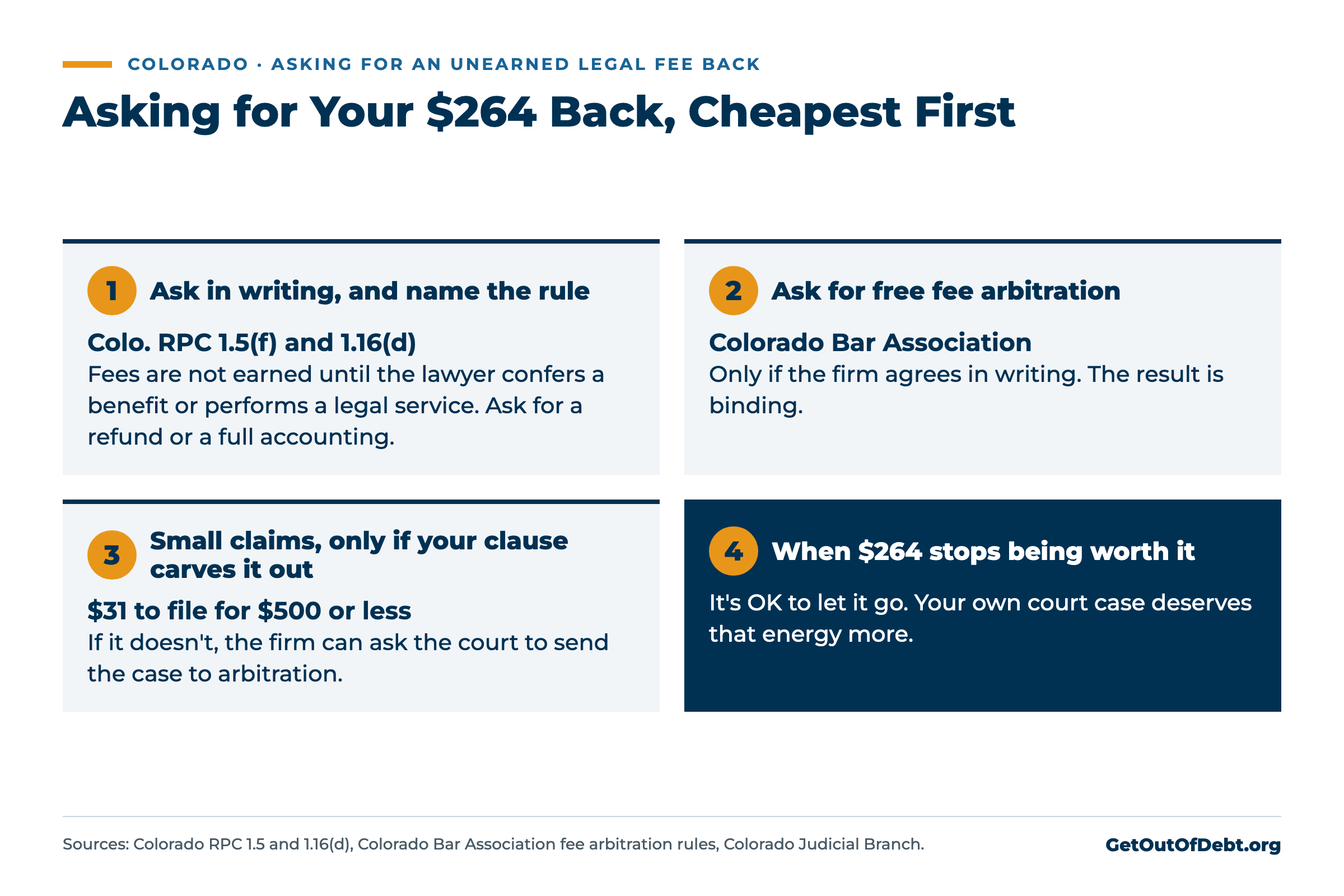
Three Ways to Ask for Your $264 Back, Cheapest First
1. Ask in writing, and name the rule
Send a short, calm letter or email and keep a copy. Stick to the money, not the call. Something like this:
“On [date], I paid a deposit of $[amount] to your firm. On [date], the firm ended the relationship, and $264 of my deposit was not returned. Colorado Rule of Professional Conduct 1.5(f) provides that fees are not earned until the lawyer confers a benefit on the client or performs a legal service, and Rule 1.16(d) calls for refunding any advance fee that has not been earned when the representation ends. Under Rule 1.5(g), nonrefundable fees are prohibited. Please refund the $264 by [a date about two weeks out]. If the agreement prices a consult, apply that rate to the time actually spent and refund the rest. If you believe it was earned, please send me a full accounting of my deposit under Rule 1.15A(b), including the billing entry showing what service earned the $264 and when that amount was moved out of any trust account. My agreement names NAM. If NAM treats this as a consumer matter, its Consumer Fee Schedule lists most arbitration costs as due from the business. I’d prefer to settle this directly or through the Colorado Bar’s free program.”
Rule 1.15A(b) says a lawyer shall, “promptly upon request by the client or third person, render a full accounting regarding such property.” A “nonrefundable” label in your contract doesn’t get around Rule 1.5(g), which prohibits nonrefundable fees. An “earned on receipt” label is a different thing: it doesn’t decide whether the $264 was earned. Whether the consult was a legal service is still the fact question, and comment [18] still reaches fees that are unearned or excessive. And sometimes a firm pays rather than answer a written request. If you paid by credit card, ask your card issuer whether a dispute is still possible.
If the firm refuses in writing and won’t say what service earned the money, a complaint to the Office of Attorney Regulation Counsel about failing to refund unearned fees is a different thing from the rudeness complaint, and you could consider it then. It promises neither discipline nor a refund.
2. Ask for free fee arbitration through the Colorado Bar Association
The Colorado Bar Association’s Legal Fee Arbitration Committee says it “provides a service that allows Colorado lawyers and their clients to resolve fee disputes at no cost to the participants.” You start with the online form on that page, or call (303) 824-5347.
The catch, from the committee’s rules: “No matter shall be referred to the Committee unless the referral to the Committee is agreed to in writing by both the complainant and the party being complained against.” Your NAM clause is part of your agreement with the firm. Using the bar program instead takes both of you signing on, the firm doesn’t have to say yes, and your contract may say how it can be changed, so read that part. The bar’s decision is also “binding and conclusive on both parties,” so if you agree to it and lose, you’re done.
One sentence you can quote back to the firm: comment [9] to Rule 1.5 says that when a bar has set up a fee dispute procedure, “even when it is voluntary, the lawyer should conscientiously consider submitting to it,” which is not a requirement, and not by itself a grievance. (I once wrote about a Florida Bar fee arbitration involving a debt relief attorney.)
3. Small claims court, only if your clause carves it out
Colorado’s small claims courts handle cases of $7,500 or less. According to the Colorado Judicial Branch, the filing fee is $31 for a claim of $1 up to $500, and fee waivers are available.
But I haven’t seen your clause, and this door is open only if your arbitration clause carves out small claims. If it doesn’t, filing first can draw a motion to compel arbitration, meaning the firm asks the judge to send the case to NAM. (Here is a case I covered that was sent to arbitration.)
If you do get there, the statute, C.R.S. § 13-6-407 (in the official Colorado Revised Statutes 2024), says an individual “shall represent himself or herself,” and states the intent that no attorney appear except in listed situations or “as permitted by supreme court rule.” The firm may still be represented by one of its own lawyers or employees, depending on how the statute’s exceptions apply.
A fund that probably isn’t for this: Colorado’s Attorneys’ Fund for Client Protection FAQ says “Claims involving fee disputes … are not eligible.” It also says “‘Dishonest’ conduct includes … refusal to refund unearned fees and costs deposits.” A disagreement over whether one consult was worth $264 sounds more like the first line than the second.
When $264 Stops Being Worth It
A letter costs a stamp and twenty minutes, and the bar program costs nothing if the firm agrees. Past that, the math stops working on a $264 claim. A partial refund is a fine place to stop. If the firm says no, it’s OK to let it go and still be right. Your own court case deserves that energy more.
Key Takeaways
- In Colorado, fees are not earned until a lawyer confers a benefit or performs a legal service (Rule 1.5(f)), and the rules call for refunding an unearned advance when the representation ends (Rule 1.16(d)). If you and the firm can’t agree on what was earned, an arbitrator or a judge decides.
- The $1,420 matches NAM’s non-consumer schedule, which may not be yours. If NAM treats you as a consumer, its filing fee is $225, so ask first.
- The Colorado Bar Association’s fee arbitration is free, but only if the firm agrees in writing, and the result is binding.
- Small claims ($31 for $500 or less) is an option only if your arbitration clause carves it out. Otherwise the firm can ask the court to send the case to arbitration.
The Bottom Line
Feeling brushed off by someone you paid to help hurts, and $264 can feel like a lot more than $264. Colorado’s rules ask one question: was that money earned? Ask in writing, offer the free bar arbitration, and read your clause before going anywhere near small claims. If the firm says no and the math stops working, it’s OK to let it go and put your energy into your own case. When you were told, in effect, to handle it yourself, you did, and that’s worth more than the $264.
Frequently Asked Questions
Can a Colorado lawyer keep a “nonrefundable” deposit?
Colorado Rule of Professional Conduct 1.5(g) says “Nonrefundable fees and nonrefundable retainers are prohibited,” and comment [18] says a lawyer’s fees “are always subject to refund if either excessive or unearned.” A lawyer may still keep what was actually earned by performing a legal service or conferring a benefit.
Is the Colorado Bar Association’s fee arbitration free?
Yes. The Colorado Bar Association says its Legal Fee Arbitration Committee resolves fee disputes between Colorado lawyers and their clients at no cost to the participants. Both the client and the lawyer must agree in writing, and the decision is binding on both.
Can I take a lawyer to small claims court if my contract has an arbitration clause?
Only if the clause carves out small claims, so read it first. If it doesn’t, filing first can draw a motion to compel arbitration, where the firm asks the judge to send the case to arbitration. Colorado small claims courts hear cases of $7,500 or less, and the filing fee is $31 for claims up to $500.
I’m not a lawyer, and I can’t see your contract, so take all of this as input, not instruction. This is what I’m telling friends like you over coffee. But remember, you do you.
Know someone who paid a professional and is still waiting for money back? Send this to them. Sometimes just knowing which door to knock on is the thing that gets someone unstuck.
Facing a Similar Situation? You’re not alone — and you have more options than you think. Start with the all your debt relief options page to see what’s realistic, or take the 2-minute bankruptcy quiz if the debt feels unmanageable. Federal Reserve Bank of New York research shows filers recover faster than those who don’t file. If a company is involved, run them through the Scam-O-Meter first.


Asked question.
Thank you so much for your question. I just answered it here.