

Quick Answer: The Department of Homeland Security’s final rule ending automatic extensions of Employment Authorization Documents (EADs) was published in the Federal Register on October 14, 2026 and took effect that day. It makes final a change DHS began on October 30, 2025: if you file to renew an EAD on or after that date, in the categories the rule covers, filing the renewal no longer keeps you authorized to work while you wait (renewals filed before that date keep the extension they already had). For many EAD holders who filed on or after that date, that means you are authorized to work through the date printed on the card and cannot work starting the next day if the new card is not approved by then. That may not apply to you if your permission to work comes from your immigration status itself rather than from the card, and that is a question for an immigration attorney or a DOJ-accredited representative, so don’t quit, stop working or cut your hours before your card’s date without asking. The money job is to plan for a possible gap now: file inside the window listed on USCIS’s Form I-765 page for your category, size a cash cushion to the day you can actually work again, not just the approval date, ask your employer in writing about leave, and call your landlord and creditors before a payment is missed.
Expert Context: I’m not an immigration lawyer, and this post is not immigration advice. What I do know, since I started helping people with debt in 1994, is the money side of an income gap: it doesn’t matter whether a layoff, an illness or a government deadline stopped the paycheck, because the rent still comes due. I read the rule itself and the agency pages so you don’t have to, and I linked them all.
If your paycheck, or the paycheck your household lives on, depends on a work permit card, a date on that card now matters more than it used to. I’m not here to argue about the policy. I’m here to help you do the math and make the money calls while you still have time.
Key Terms Defined
Employment Authorization Document (EAD): The work permit card, Form I-766, that USCIS issues as evidence you are allowed to work in the United States (91 FR 65306).
Each weekday I send one short email: one story that caught my attention, why it might matter to you, and one manageable thing you can do with it. A couple of minutes, and a dad joke.
In the latest issue (Oct 16): The check that looks like a scam may be real
Free. I sell nothing. Unsubscribe any time.
Automatic extension: The old practice of treating a timely renewal filing as keeping your work authorization alive, for up to 540 days, while USCIS decided the renewal. For renewals filed on or after October 30, 2025, in the covered categories, it no longer exists.
Employment authorized incident to status: Some people’s permission to work comes from their immigration status itself, not from the card. The rule uses the spouse of an L-1 worker in L-2 status as its example: that person stays work-authorized while the status lasts, even after the card’s date passes, but the expired card stops being proof of it.
Gap (or lapse): For people whose permission to work comes from the card, the stretch that starts the day after the date printed on the card and runs until a renewal is approved, when you cannot legally work. DHS’s own word for it is a “lapse.”
What the Rule Says, in Plain English
Here is what I confirmed by reading the rule itself, which is Federal Register document 2026-20955 (PDF):
- It’s a final rule, not a proposal. It says it is “effective on October 14, 2026.”
- It isn’t new policy; it makes an existing one permanent. DHS published an interim final rule on October 30, 2025, and says this final rule “adopts the IFR as final, without any changes.” That means the end of automatic extensions has applied to new renewal filings since October 30, 2025. This week’s rule is the finish line, not the starting gun.
- The cutoff is the day you filed, not the day your card expires. In DHS’s words, renewal applicants “no longer receive an up to 540-day automatic extension of their employment authorization and/or EAD validity if they file their application on or after October 30, 2025.” If your renewal was filed before that date, the rule says the extension you already got under the old rule is not affected.
- It covers “certain” categories. DHS describes the change as applying to people who timely file a renewal “in certain employment authorization categories.” It leaves alone extensions that are provided by law or by a Federal Register notice, such as the ones used for Temporary Protected Status (TPS) paperwork.
- DHS’s stated reason is that ending the extensions “enhances benefit integrity” and puts vetting and screening before a new period of work authorization. DHS also says in the rule that lapses “can create real hardship for affected aliens, their families, their employers and the communities in which they live.” I’m not weighing in on the policy. Both of those statements are in the rule, and I’m giving you both.
The rule gives a worked example that I think is the clearest explanation of the money problem. A person with a pending green card application has an EAD that expires on May 30, 2026. They file to renew on February 4, 2026, after the October 30, 2025 cutoff. If the renewal is approved before May 30, work continues without a break. If the renewal is still undecided on May 31, DHS says that person cannot keep working for the employer unless they are work-authorized on some other basis. If the renewal is approved later, the rule says the person “may resume employment during the validity period stated on the new EAD.” That’s a paycheck that stops on a date you can see coming, for a length of time nobody can promise you.
Why You Need to Know This: The Gap Is a Cash-Flow Problem
Whatever you think of the rule, the arithmetic is neutral. For the cards the rule covers, a pending renewal used to bridge the date on the card. Now the card’s date can be a hard stop. DHS even says plainly in the rule that “proper planning might not avoid a temporary lapse in employment authorization and/or documentation in all cases,” but “should help to reduce the potential of a lapse and shorten the duration if a lapse were to occur.”
Read that sentence the way a budget reads it: a gap is possible, nobody can tell you how long it will be, and the bills keep their own calendar. Debt is math wrapped in emotion, and this is a case where the emotion arrives first. The math is something you can do today.
The Daily Money Brief — Free, at 10 AM
Money you may be owed, scams to dodge, and the fine print decoded — the consumer money news that affects your wallet, every weekday.
Who This Touches, and Who It May Not
I can’t tell you which group you are in. Your category, which is on your card, decides it, and so does your immigration attorney or accredited representative. Here is how the rule describes the two broad groups:
- Your permission to work comes from USCIS granting it, and the card is the grant. The rule’s examples are people with a pending adjustment of status (green card) application or a pending asylum application. For them, the rule says your authorization runs through the date printed on the card and you cannot work starting the next day. This is the group where a pending renewal can leave a gap.
- Your permission to work comes from your status. For them, the rule says the authorization lasts as long as the status does, not until the date on the card. The card expiring changes what proves your authorization (the rule’s L-2 example points to the Form I-94 as other evidence), so ask your representative what your employer will need to see.
- TPS and other law or notice-based extensions. The rule says it does not change extensions that are “provided by law” or through a Federal Register notice. Check the current notice for your designation, not a social media post.
Unemployment insurance probably won’t fill the gap, and you should ask before you plan around it
Unemployment insurance is run by the states, so details differ, and I could not find a primary source that settles a pending-renewal gap for any particular state. Here is what the federal sources do say:
- Federal law lets a state pay benefits based on work done by a non-citizen only if the person was a lawful permanent resident, “lawfully present for purposes of performing such services,” or permanently residing in the U.S. under color of law when the work was done (26 U.S.C. 3304(a)(14)(A)). That’s about the wages you earned.
- The U.S. Department of Labor adds a second test for the weeks you claim. In Unemployment Insurance Program Letter 01-86, it says a claimant must be “able and available” to work and that a non-citizen “without current, valid authorization to work” is “not legally available for work and not eligible for benefits.” The letter also says wage credits earned while authorized can still be used to establish a claim.
That letter is from 1985 and carries a printed expiration date of 1987, though the Labor Department’s claims-review handbook still cites it and says a claimant must be “currently legally authorized to work.” States apply their own rules, so don’t read it as the last word on your claim. But it points in one direction: do not build a plan that assumes unemployment benefits will arrive during weeks when your authorization has lapsed. If you are laid off, or placed on leave, for any reason, call your state unemployment office and ask directly. Then you know instead of guessing.
Your employer has its own legal obligations, and the rule doesn’t say what they will do with your job
The example above says the person cannot keep working for the employer, so the employer has a decision to make. I did not find anything in the rule that requires an employer to hold a job open, so whether you get unpaid leave, a suspension or a termination depends on the employer’s policy and your state’s law. That is a conversation you want to start early, in writing, while there’s still time on the card.
A rejected or misdirected filing can cost you the very days you were trying to save
USCIS’s Form I-765 page currently carries two alerts worth knowing about. The filing location for mailed Form I-765 changed on October 7, 2026, and USCIS says it will accept forms postmarked on or before November 9, 2026 that were sent to a prior location. Separately, USCIS announced inflation adjustments to certain fees for requests postmarked on or after October 16, 2026. Its announcement says its table “outlines all the fee changes in the Federal Register notice,” and the only Form I-765 row in that table is for “if you are applying for an initial” asylum applicant, parole or TPS work permit. USCIS also says any request postmarked on or after October 16, 2026 without the proper fee will be rejected. Fees differ by category, so confirm the current fee for yours on USCIS’s fee schedule before you mail, and don’t rely on a figure from memory or from me.
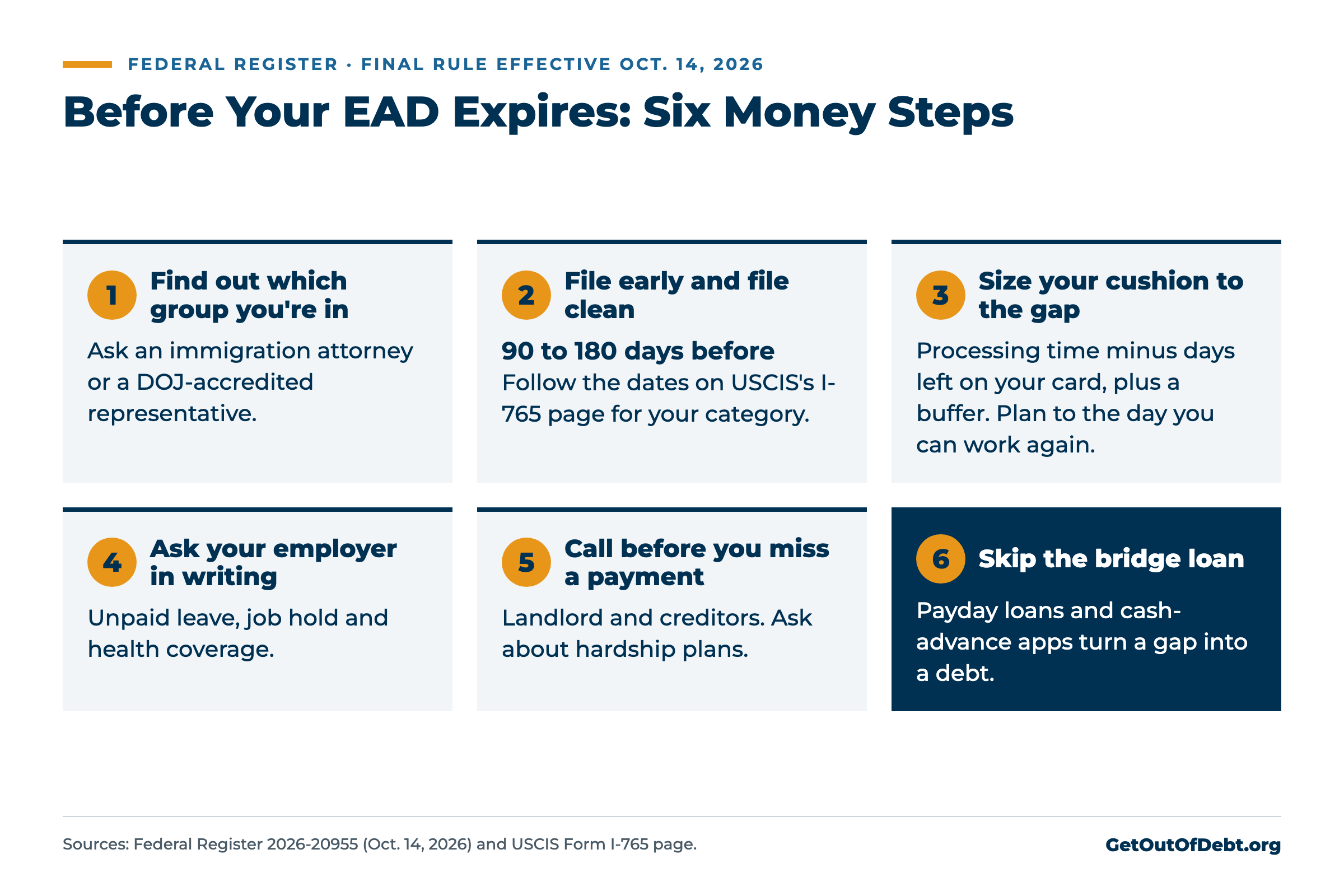
What I’d Do Before the Card Expires
Here are seven steps, in the order I’d take them. The graphic above shows the first six.
1. Find out which group you’re in
One conversation with an immigration attorney or a DOJ-accredited representative is worth more than any amount of reading online. The Department of Justice publishes a roster of recognized organizations and accredited representatives, and a list of pro bono legal service providers. USCIS also explains who is allowed to give legal help and how to find it. Use those, and be careful with anyone else who offers to handle your forms. Do not stop working before the date on your card unless an attorney or representative tells you your authorization has already ended.
2. File early, inside USCIS’s recommended window, and file clean
USCIS’s Form I-765 page says it generally recommends filing a renewal up to 180 days before your current card expires, and also says to file at least 90 days before the expiration. Follow the dates that page lists for your category, because some categories have different windows. The rule itself says there is “no prohibition on filing the form before a certain date ahead of expiration,” and USCIS says, “We generally do not backdate or postdate a renewal EAD to the end of your current EAD’s validity period.” Send everything the form asks for the first time, to the right address, with the right fee, on the form edition USCIS says it is currently accepting (its I-765 page says which), because a rejection can burn the weeks you were counting on.
Mailing on or after October 16, 2026? Confirm the current fee for your category first, because a request with the wrong fee is rejected.
3. Do the gap math
Add up your essentials for one month: housing, utilities, food, transportation, insurance, and the minimum payments you can’t skip. That’s your monthly floor. Then look up USCIS’s processing time for your form and category, and compare it with the days left between the date you file and the end date on your card. USCIS’s processing time minus the days you have left on your card is the possible gap. Size your cushion to that gap plus a buffer, because processing times are past figures, not a promise. Approval lets you go back to work, but it does not pay you for the weeks you could not work, so those are lost wages, not delayed ones. The date you can work again depends on approval and on showing your employer what it needs to re-verify you (usually the new card), so plan the cushion to that day, not just the approval date. Subtract the cash you have, and the number left is the hole you’re planning for. As an illustration only: if your floor is $3,000 a month and the gap could run two months, the target is $6,000. If you have $2,000, the hole is $4,000. That number is more useful than dread, because you can attack it from several sides: save, trim, negotiate, and line up help.
4. Ask your employer, in writing, what happens to the job
Ask whether unpaid leave is available if your renewal isn’t approved in time, whether the job can be held, how re-verification would work when the new card arrives, and what happens to employer health coverage during any leave. Keep the reply. A written answer is worth more than a verbal reassurance if anything changes.
5. Call your landlord and creditors before a payment is missed
This is the cheapest money move in the post. Creditors and landlords hear “I may have a gap in income starting on a specific date, and here’s my plan” very differently from “I’m already behind.” Ask your landlord about a payment plan or a date change, and ask each lender or card issuer whether it has a hardship program. Get anything they agree to in writing. My post on credit card hardship programs explains what to ask for, and the guide on what to do when you lose your job and can’t pay your debts walks through the order I’d pay things in. Keep the essentials first: a roof, utilities, food, transportation and insurance come before cards.
6. Skip the bridge loan
When a paycheck stops, a payday loan or a cash-advance app looks like a bridge. In my experience it’s a second problem: you borrow against a paycheck that isn’t coming on a date nobody can promise, and then you have a debt on top of the gap. I’ve written about earned-wage-access apps that work like payday loans, how to escape a payday loan cycle, and where to turn for emergency money that isn’t a payday lender.
7. Don’t let a debt collector scare you about your status
Money trouble and immigration fear can get tangled together, and a collector who threatens deportation over a debt is a red flag. If anyone does that, read my guide on what to do when a debt collector threatens deportation first.
If the Gap Is Bigger Than Your Cushion
Then you have a debt problem on top of an income problem, and I want you to know all your options before you decide anything. Hardship programs, payment plans and trimming are the first things I’d try. Bankruptcy isn’t off the table either: the Bankruptcy Code says a person who “resides or has a domicile, a place of business, or property in the United States” may be a debtor (11 U.S.C. 109(a)), and it doesn’t say citizen. Whether filing could affect your immigration case is a question for your immigration attorney before you file anything. I filed bankruptcy myself in 1990 after my real estate business collapsed, and what I learned is that deal with it and look to the future beats spending five years repairing the past. Use the Find Your Path quiz to see which options fit your numbers.
Key Takeaways
- The final rule, published October 14, 2026 and effective that day, adopts DHS’s October 30, 2025 interim rule “without any changes.” Renewals filed on or after October 30, 2025 in the covered categories no longer carry an automatic extension.
- Renewals filed before October 30, 2025 keep the extension they already had, and extensions provided by law or Federal Register notice, such as for TPS, are left alone.
- File inside the window listed on USCIS’s Form I-765 page for your category, and know that DHS itself says planning may not prevent a gap in every case.
- Don’t plan on unemployment benefits during a lapse. An older Labor Department guidance letter says a claimant needs current, valid work authorization to be “available for work,” and states apply their own rules, so ask your state office.
- Do the gap math against USCIS’s processing time, ask your employer about leave in writing, and call your landlord and creditors before a payment is missed. Skip payday loans and cash-advance apps as a bridge.
The Bottom Line
If a date on a plastic card now decides whether a paycheck continues, your worry makes sense, and it isn’t a character flaw or a sign you did something wrong. Right now this is not a debt problem. It’s a calendar and a math problem, and both are things you can work on before anything is missed. File early, learn your number, ask your employer for the plan in writing, and talk to the people you owe before they have to chase you. The best time to deal with a gap is before it exists, and reading this is you doing exactly that.
Frequently Asked Questions
Short answers to the questions I’d expect, based on the sources linked above.
Does my work permit still get an automatic extension if I file a renewal?
It depends on when you filed and on your category. DHS’s final rule, published October 14, 2026 and effective that day, says renewal applicants no longer receive the up-to-540-day automatic extension if they file on or after October 30, 2025. Renewals filed before that date keep the extension they already had, and extensions provided by law or Federal Register notice, such as for TPS, are not changed. Confirm your category with an immigration attorney or accredited representative.
How early can I file to renew my EAD?
USCIS’s Form I-765 page says it generally recommends filing a renewal up to 180 days before your current EAD expires, and also says to file at least 90 days before the expiration. Some categories have different windows, so follow the dates that page lists for yours before you mail.
Can I collect unemployment if my EAD expires while my renewal is pending?
Don’t count on it. Federal law limits state benefits based on non-citizen work to people who were permanent residents, were lawfully present to do that work, or were permanently residing in the U.S. under color of law when they did it, and Department of Labor guidance (Unemployment Insurance Program Letter 01-86) says a claimant without current, valid work authorization is not legally available for work and not eligible for benefits. That letter dates from 1985 (its printed expiration date is 1987, though a Labor Department handbook still cites it) and states apply their own rules, so ask your state unemployment office before you plan around it.
Can my employer keep my job open while my renewal is pending?
The rule doesn’t say. DHS’s example says a person whose renewal was still pending when the card’s date passed cannot continue working for the employer unless they are work-authorized on some other basis, and that if the renewal is later approved, the person “may resume employment during the validity period stated on the new EAD.” Whether the job is held, through unpaid leave or otherwise, is up to your employer’s policy and your state’s law, so ask in writing before your card’s date.
Should I take a payday loan or cash-advance app to cover a gap?
I wouldn’t. Borrowing against a paycheck that has no return date turns a temporary gap into a debt problem. Start with the cheaper calls: ask your landlord for a payment plan, ask lenders about hardship programs, and read my guides on payday loan alternatives before you borrow.
I’m not an immigration lawyer, and I can’t see your category, your case or your employer’s policies, so take all of this as input, not instruction. This is what I’m telling friends like you over coffee. But remember, you do you.
Know someone with a work permit renewal coming up, or a family that lives on that paycheck? Send this to them. A plan made before the date is the cheapest money move there is.
Dealing With Debt? Understanding your options is the first step. See how all your debt relief options compare — including ones most sites won’t tell you about. The Find Your Path quiz gives a recommendation based on your actual numbers, and the Scam-O-Meter checks any company’s complaint history before you sign. Federal Reserve Bank of New York research shows bankruptcy filers recover faster than those who don’t file.