

Fact-checked by Steve Rhode, consumer debt expert since 1994 • Last reviewed July 7, 2026 • Every claim below links to a primary source.
The verdict: MYTH. Older federal income tax debt can be discharged in bankruptcy — it just has to clear a set of timing tests first. The blanket claim that “the IRS always survives” is false, and believing it stops people from getting relief they’re legally entitled to. The bankruptcy code’s own discharge exceptions, at 11 U.S.C. § 523(a)(1), spell out exactly which taxes escape discharge — and which don’t.
Well, Actually…
Here’s the part almost nobody tells you: bankruptcy and tax debt aren’t oil and water. It’s true that a lot of tax debt can’t be wiped out — and I’ll be honest with you about every one of those situations below. But “a lot” is not “all,” and the difference matters enormously if you’re lying awake doing math on money you can’t pay.
The rule of thumb, in plain English: older federal income taxes can be discharged; recent ones usually can’t. The law draws that line with three timing tests, and the tax generally has to clear all three at once to be dischargeable in a Chapter 7:
- The 3-year test. The tax return was originally due (including any extension you filed) more than 3 years before your bankruptcy filing date.
- The 2-year test. You actually filed that return more than 2 years before you file for bankruptcy.
- The 240-day test. The IRS assessed the tax more than 240 days before you file.
Those windows come straight from the priority-tax rules at 11 U.S.C. § 507(a)(8) and the discharge exceptions at § 523(a)(1). If a tax is old enough to fall outside all three windows, it’s no longer a “priority” debt the code protects — and it can be discharged like most other unsecured debt. I’ve watched people carry a decade-old tax bill around like a life sentence when it was already, legally, dischargeable.
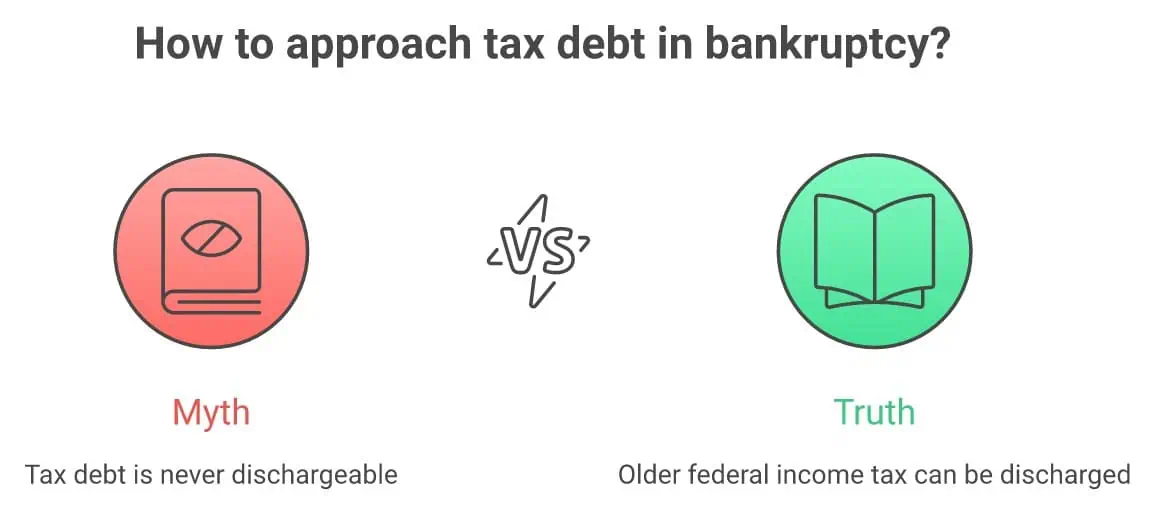
You can never discharge tax debt in bankruptcy — the IRS always survives.
Federal income tax debt can be discharged in bankruptcy when it’s old enough to pass the 3-year, 2-year, and 240-day timing tests at the same time — and there’s no fraud or evasion involved. Recent taxes, payroll (trust-fund) taxes, and taxes tied to a fraudulent return are the ones that survive. “Never” is simply wrong.
But Here’s Where People Get Hurt — The Checklist Is a Starting Point, Not a Finish Line
I need to be straight with you, because this is your money and your future. Passing those three timing tests tells you a tax might be dischargeable. It does not guarantee it. There are five traps that can quietly defeat the discharge even when the dates look right — and this is exactly why you do not do this math alone at your kitchen table:
- Fraud or evasion is a permanent bar. If the tax came from a fraudulent return, or you willfully tried to evade it, it’s never dischargeable — no matter how old — under § 523(a)(1)(C). That’s a fourth disqualifier the “three tests” shorthand leaves out.
- A return you never filed doesn’t start the clock. If you never filed the return for a given year, that tax is permanently non-dischargeable under § 523(a)(1)(B)(i). And if the IRS filed a “substitute for return” before you filed your own, some courts hold your later filing doesn’t count — which can bar the discharge entirely, depending on where you live. That’s why I tell cash-paid workers to file every year, even when they can’t pay.
- The clocks can be paused (“tolled”), and not evenly. A prior bankruptcy can extend both the 3-year and 240-day windows. An Offer in Compromise tolls the 240-day clock (plus 30 days) right in the statute, but does not clearly extend the 3-year window. A standard IRS installment (payment) plan generally does not pause these clocks at all — and the 2-year filing clock has no tolling of any kind. The upshot: if you’ve had a prior bankruptcy or an Offer in Compromise, the calendar can lie, and your real eligibility date is later than it looks. Don’t do this math yourself.
- A tax lien survives your discharge. If the IRS recorded a Notice of Federal Tax Lien against your home before you filed, that lien stays attached to the property even after your personal liability is wiped out. The IRS can’t chase you personally — but you may still have to pay the lien to sell or refinance. Check for filed liens before assuming discharge solves everything.
- Chapter 13 works differently — and sometimes better. If your tax debt is too recent to discharge in Chapter 7, a Chapter 13 plan can restructure it: recent (priority) taxes get paid in full over 3–5 years — penalties usually stop accruing, though interest keeps running at the rate set by § 511 and must be paid as part of the plan. Older taxes that have already cleared the timing tests are treated like other unsecured debt and can be paid at a small percentage. For a lot of people with newer tax debt, Chapter 13 is the better door.
Why You Were Told “Never”
Two reasons, and neither one is about your best interest. First, “never” is easier to say than the honest, nuanced answer — so it gets repeated until it sounds like law. Second, there’s a whole industry of “tax resolution” firms that charge thousands of dollars to negotiate with the IRS on your behalf. If you believed bankruptcy could sometimes erase an old tax bill for a fraction of that, you might not hand them a retainer. I’m not selling you either option. I’m telling you both exist so you can pick the right one for your situation.
What to Actually Do
- Pull your account transcripts first. Get your IRS account transcripts for every year you owe — they show the assessment dates and filing dates the timing tests depend on. You can request them free at IRS.gov/transcript.
- Read the deep-dive. I’ve written out exactly how the three timing rules work, step by step, here: Can Bankruptcy Erase Tax Debt? Yes — Here’s Exactly When It Can. And if you’re worried about your retirement, here’s why your 401(k) and IRA are protected and you should never drain them to pay the IRS first.
- Talk to a bankruptcy attorney who handles tax cases. This is not optional. The tolling math, the substitute-for-return trap, and the lien question are exactly where a $200 consultation saves you tens of thousands. Find one through NACBA, or talk to Damon Day for free about which path fits your numbers. Damon Day, an independent debt coach and my co-host on the Get Out of Debt Guy podcast, whom you can reach at DamonDay.com — I receive no payment for this referral.
Steve’s Take
I filed bankruptcy in 1990, so I know the specific shame that comes with owing the government money — it feels more permanent, more official, than any other debt. But the IRS is not magic. It operates under the same bankruptcy code as everyone else, and that code has an off-ramp for old income taxes. In 30 years I’ve seen people pay tax-resolution firms thousands to “fight” a bill that bankruptcy would have erased for the cost of a filing fee. The tragedy isn’t the tax debt — it’s not knowing your options. Now you know one more.
Frequently Asked Questions
Can I really discharge IRS tax debt in bankruptcy?
Yes — older federal income tax debt can be discharged if it passes the 3-year, 2-year, and 240-day timing tests together and there’s no fraud involved. Recent taxes and payroll taxes cannot. See 11 U.S.C. § 523(a)(1).
How old does my tax debt have to be to wipe it out?
As a rule of thumb, the return needs to have been due more than 3 years ago, actually filed more than 2 years ago, and assessed by the IRS more than 240 days ago — all at once. Certain events (a prior bankruptcy, or an Offer in Compromise) can push those dates later, so the calendar alone can mislead you. This is exactly the kind of timing a bankruptcy attorney should confirm from your IRS transcripts.
What tax debt can never be discharged?
Payroll and trust-fund taxes (like withheld employee taxes) are never dischargeable under § 507(a)(8)(C). Neither is any tax tied to a fraudulent return or willful evasion, or a tax year for which you never filed a return. Those survive bankruptcy no matter how old they are.
Does bankruptcy get rid of a tax lien?
Not always. If the IRS recorded a Notice of Federal Tax Lien against your property before you filed, that lien survives your discharge and stays attached to the property — even though the IRS can no longer collect from you personally. You may still have to satisfy it to sell or refinance. That is a federal income tax lien, though — a county property tax lien sale is a different, faster-moving problem; see what to do if yours was sold.
Is Chapter 7 or Chapter 13 better for tax debt?
It depends on how recent the debt is. Chapter 7 can fully discharge old income taxes that pass the timing tests. Chapter 13 restructures recent taxes into a 3–5 year plan — penalties usually stop accruing, though interest keeps running and must be paid in full — and older taxes that already cleared the timing tests can be paid at a small percentage as unsecured debt. For newer tax debt, Chapter 13 is frequently the better choice.
Do these rules apply to state income taxes too?
This framework covers federal income taxes. Many states follow similar patterns, but state tax treatment isn’t automatic and varies — verify your state’s rules separately with an attorney.
Should I hire a tax-resolution company instead?
Be careful. Many charge thousands for services you may be able to get for far less — and some sell “solutions” that don’t fit your situation. Before you pay anyone, understand whether bankruptcy, an IRS payment plan, or an Offer in Compromise is actually your best path. A one-time consult with a bankruptcy attorney is usually money far better spent.
One more thing — everything here is based on 30 years of helping people through exactly this, but my advice is input for your decision, not the decision itself. Tax-and-bankruptcy timing is genuinely tricky, and only an attorney looking at your actual transcripts can tell you where you stand. Take this as a map, not a verdict.
The bottom line: “You can never discharge tax debt in bankruptcy” is a myth — old enough federal income taxes can be wiped out, while recent taxes, payroll taxes, and fraud-tainted taxes cannot. If someone you know is being crushed by an old IRS bill and thinks bankruptcy can’t help, send them this — it might change everything for them.
Also on IRS myths: They Said the IRS Will Take Your House and Throw You in Jail for Back Taxes — the precise legal requirements for home seizure and criminal prosecution.
Dealing With Debt? Understanding your options is the first step. See how all your debt relief options compare — including ones most sites won’t tell you about. The Find Your Path quiz gives a recommendation based on your actual numbers, and the Scam-O-Meter checks any company’s complaint history before you sign. Federal Reserve research shows bankruptcy filers recover faster than those who don’t file.