
Quick Answer: A check from the FTC about Walmart money transfers can be real, and a fake can look convincing, so before you cash or deposit anything, type ftc.gov/refunds into your browser, find the Walmart case and the administrator’s phone number there (not on the letter), and call to ask whether a check was issued to you, in your name, for that amount. On October 15, 2026, the FTC announced it is sending 65,022 checks totaling more than $9.8 million to people who completed eligible money transfers at Walmart between January 2015 and December 2024. Cash or deposit it by the 90-day deadline shown on the check, which may not be 90 days from today. The FTC says it never requires people to pay money or provide account information to get a payment.
Expert Context: I have covered FTC refund programs, and the fake offers that imitate them, on this site for years, and I have spent 30 years in debt help, where a scam loss and a stack of unpaid bills can show up in the same conversation.
The FTC says checks are going out to people who completed eligible money transfers at Walmart, as part of a case about scammers who used Walmart’s money transfer services. Scammers also pose as the FTC, and in my opinion people who already sent money to one scammer are exactly who a second scammer would pick. Here is how to tell a real check from a fake, what to do if you were missed, and what I would do if the scam left you behind on bills.
What the FTC Says Is Happening
In its October 15, 2026 announcement, the FTC said it is sending payments totaling more than $9.8 million to consumers harmed by Walmart’s alleged failure to stop scammers that took hundreds of millions of dollars from U.S. consumers using the company’s wire transfer services. The FTC’s Walmart refund page says the checks go to people who completed eligible money transfers at Walmart between January 2015 and December 2024. Everything about Walmart on this page is the FTC’s account of the case, not my own findings.
The money comes from a settlement. In June 2025, Walmart settled the FTC’s charges and agreed to a $10 million judgment. The stipulated order the FTC filed says Walmart “neither admits nor denies any of the allegations in the Complaint” (apart from the facts needed to establish jurisdiction), so everything the FTC says Walmart did is an allegation, not a finding.
Key Terms Defined
Refund administrator: A private company the FTC hires to send payments and answer questions. For this program the FTC names Rust Consulting, Inc. as the refund administrator.
Stipulated order: A court order both sides agree to. The FTC’s release notes that stipulated final orders have the force of law when approved and signed by the District Court judge.
Pro rata: Each person gets an equal percentage of their own loss. The FTC’s refund FAQ says that is how most FTC cases are paid when there is not enough money for full refunds.
Who Is Getting a Check, and How Much
The FTC’s wording is people who completed eligible money transfers at Walmart between January 2015 and December 2024. Its release says the FTC is sending checks to 65,022 affected consumers. Some things the FTC’s pages do not say, and I am not going to guess:
The Daily Money Brief — Free, at 10 AM
Money you may be owed, scams to dodge, and the fine print decoded — the consumer money news that affects your wallet, every weekday.
- Which transfers counted as “eligible.” The FTC’s pages say “eligible money transfers” and do not spell out which transfers counted. If you are unsure whether yours did, call the administrator (get the number from ftc.gov/refunds) rather than guess.
- The amount of any one check. No per-person figure appears. More than $9.8 million divided by 65,022 checks works out to roughly $150 each on average. That is my arithmetic, not an FTC figure, and individual checks could be higher or lower.
- How the list was built. The order requires Walmart to provide available customer information related to fraud-induced money transfers so the FTC can administer redress, and, if a representative of the Commission (the FTC) requests redress-related information in writing, to provide it within 14 days. The FTC’s refund FAQ says it may also search its Consumer Sentinel database. Which of those was used for this list, the FTC does not say.
- The date range. The FTC’s 2025 release describes the complaint as covering conduct between 2013 and 2018, while the refund page covers transfers from January 2015 to December 2024. The pages do not explain the difference.
- Why the total is a little under $10 million. The order lets the FTC use the money for redress and “any attendant expenses for the administration of any redress fund.” I am not claiming that is where the difference went, because the FTC does not say.
What To Do With Yours
- It is a check. The FTC’s page says it is sending checks. Its pages for this program mention no PayPal payment, so if a PayPal payment or email about a Walmart refund shows up, check it at ftc.gov/refunds before you touch it.
- Cash or deposit it within the 90 days shown on the check, after you check that it is real (see below). The FTC says recipients should cash their checks within 90 days, as indicated on the check. I found no mailing date on the FTC’s pages, so the deadline shown on your check is the one that counts. If you can, deposit it at your own bank or credit union rather than paying a check-cashing fee. My advice: your bank showing the money as available does not mean the check is good; if a check turns out to be fake, you owe that money back to the bank.
- Questions: call the refund administrator, Rust Consulting, at the number listed on the FTC’s Walmart refund page (1-833-472-1990 when I checked). Confirm that number on the FTC page yourself rather than taking it from a letter, an email, or a copy of this article.
- Check expired: the FTC’s general refund FAQ says it may be reissued if money is still available in the settlement fund. Call and ask.
- Name change, death or a spelling error: the same FAQ says you must request a new check in writing by mail or email, and to call for details.
- Taxes: the FAQ says the FTC generally does not issue 1099s, includes one with the check where it is required to report the payment, says that if you receive a 1099 with your check you should report the payment as income on your tax return, and suggests asking a tax advisor.
Check It Before You Cash or Deposit It
The FTC’s refund page warns that scammers are impersonating the FTC and says the FTC will never threaten you, say you must transfer money to “get a refund,” or promise you a prize. The FTC’s refund FAQ adds that it never requires upfront fees or asks for sensitive information like your Social Security number or bank account information, and that anyone claiming to be the FTC and asking for money is a scam.
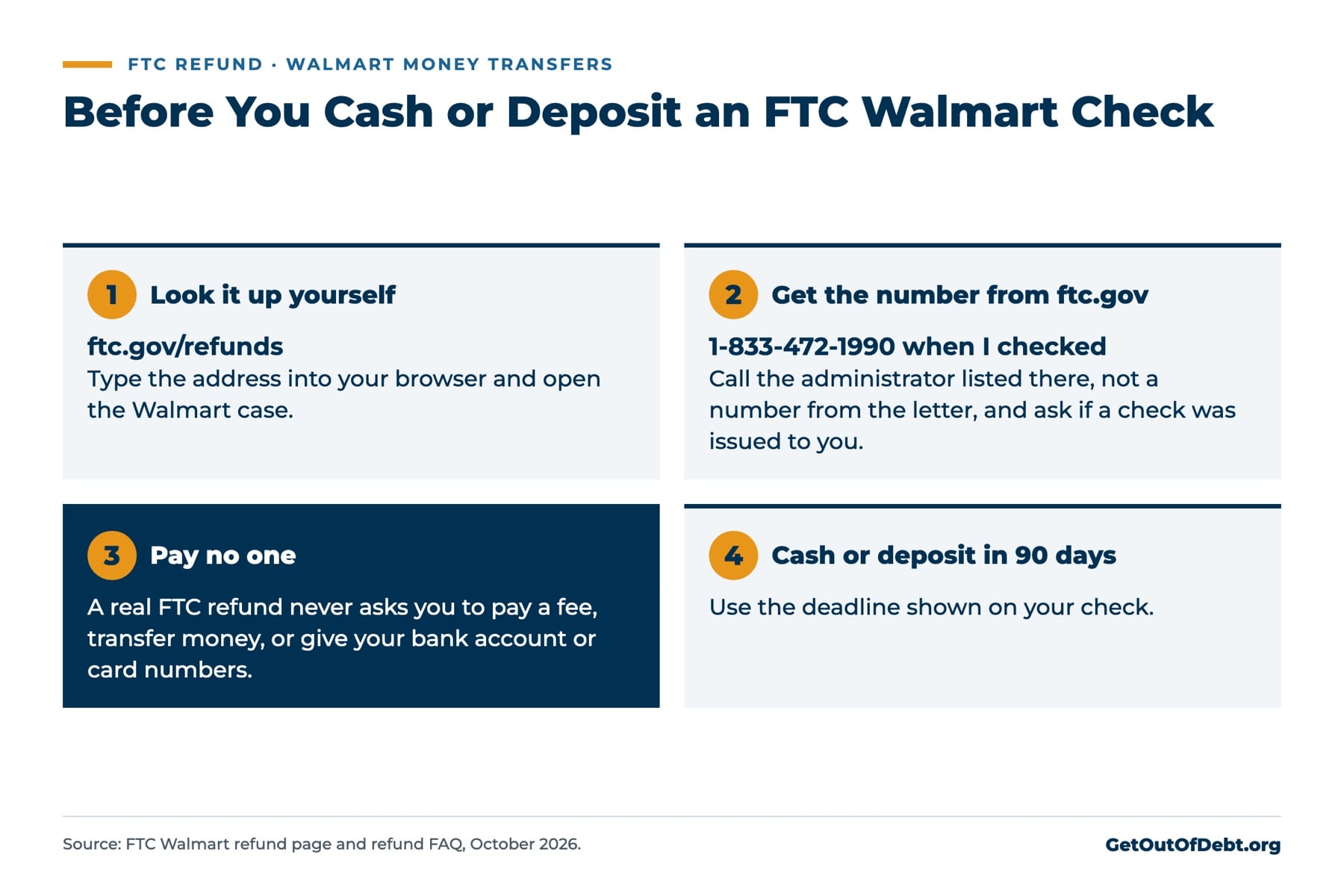
- Look the case up yourself. Type ftc.gov/refunds into your browser. The FTC says each refund case is listed there with the company issuing payments and a phone number for questions.
- Get the phone number from ftc.gov, not from the letter. The FTC’s FAQ says you can find and verify the phone numbers for FTC refund programs at ftc.gov/refunds. My advice: a number printed on a check or letter proves nothing, because anyone can print a phone number. For Walmart, the FTC’s page listed Rust Consulting at 1-833-472-1990 when I checked. Call the number you found on ftc.gov and ask whether a check was issued to you, in your name, for that amount.
- Click nothing in an email. The FTC’s FAQ says not to click links in emails that seem to be from the FTC. Type the web address yourself.
- A real FTC refund never asks you for money or account details. The FTC says it never requires people to pay money or provide account information to get a payment. If anyone says you must pay a fee or transfer money to get the refund, or asks for your bank account or card numbers, stop. That is the opposite of what the FTC says it does.
Before You Hire Anyone to “Recover” Your Money: The FTC’s pages describe no fee-based recovery service for this refund. Run anything a company sends you through the free Contract Decoder, and check the company with the Scam-O-Meter first.
My opinion, not an FTC finding: any list of people who sent money to a scammer would be the best lead list a second scammer could ask for. Someone who already lost money to one voice on the phone is the person a second voice on the phone is likely to call. If someone calls you about this refund, hang up and call the number you found yourself. I wrote about the same thing with the FTC’s GOAT refund checks, the Cleo AI refund payments, and the Justice Department’s Western Union compensation phase.
If You Think You Were Missed
The FTC names one contact: the refund administrator, Rust Consulting, at the number listed on ftc.gov/refunds (1-833-472-1990 when I checked). Beyond that, the FTC’s Walmart pages are thin. They mention no claim form and no appeal, and they do not say whether someone who is not among the 65,022 can still get a payment. The FTC’s general refund FAQ says most FTC cases do not require a claim and that if the FTC does not have what it needs to send refunds, it may ask people to file one, with the instructions posted at ftc.gov/refunds. So my advice is simple. Call the number, ask whether your transfer is in the data, and write down the date, the name of the person you talked to, and what they said. If more than one person in your house sent money, ask about each of them.
Whatever happens with this program, ReportFraud.ftc.gov is where you report a scam. The FTC’s FAQ says reports to it and other agencies are part of the Consumer Sentinel database it may search to find eligible recipients, so a report can help the FTC in future cases, though the FTC does not say it changes this one.
About the Case Behind the Checks
The FTC sued Walmart in June 2022. According to the FTC’s 2025 settlement announcement, the complaint alleged that between 2013 and 2018, Walmart, including in its capacity as an agent of MoneyGram, Western Union and Ria, allowed its money transfer services to be used by scammers who defrauded consumers out of hundreds of millions of dollars, that it failed to implement effective anti-fraud policies and procedures, did not properly train its employees, and failed to warn customers about potential fraud. Those are the FTC’s allegations in the complaint.
The same announcement describes the road to the settlement. The FTC filed an amended complaint in June 2023, in July 2024 the district court dismissed the FTC’s Telemarketing Sales Rule claim for the second time, which the FTC called a significant hurdle to obtaining money for consumers, and in November 2024 the Seventh Circuit Court of Appeals granted Walmart permission to appeal certain rulings. The case was in the U.S. District Court for the Northern District of Illinois, and the FTC says the commission vote approving the settlement was 3-0. Under the order, Walmart must take appropriate action to detect and prevent fraud-induced money transfers, and it is barred from sending or paying out a transfer it knows, or consciously avoids knowing, is fraud-induced.
If a Scam Took Your Money and You Are Behind on Bills
A check like this can matter and it is not a rescue. If your check is anywhere near that rough $150 average, it covers one bad week, and it does not repay what a scammer took. The FTC’s FAQ says that in most of its cases, when money is short, payments are made pro rata. It does not say how this program was calculated, so your check may be only a part of what you lost. That is not you failing. Debt is math wrapped in emotion, and the emotion here is shame, which is what scammers rely on to keep people quiet.
- Verify first, then decide. Do not spend a check you have not checked.
- Put the money where it protects you most. In my experience that means keeping a roof over your head, the lights and heat on, food in the house, and a way to get to work before it goes toward anything else.
- Call the lender before you miss the next payment. Ask what hardship options exist. It is free, and “a scam cost me money I needed for this bill” is a true and ordinary thing to say.
- Do not borrow to cover the gap without doing the math. Payday loans and cash advances can turn one loss into two problems. I walk through the alternatives in finding emergency money when your credit is bad.
- If the math no longer works, look at every option, not just the one you have heard of. My options comparison and the 2-minute bankruptcy quiz lay them out side by side, and bankruptcy is one of them.
Other readers have written me about the same thing: one about debt left behind after being scammed, another about getting caught up on back payments. And if you want to know what else is moving through the FTC’s refund pipeline, see my FTC refunds roundup and how to tell a real settlement notice from a fake one.
My Take
A surprise check is nice, and a surprise check is exactly what a scam looks like, so be happy and slow. Check it, then cash or deposit it, because even a small check is your money. If anything asks you to pay or share account details, stop. If you are underwater because someone took money from you, that is information about the scammer, not about you. You are not your debt, and one hard hit does not decide the rest of your story.
Key Takeaways
- The FTC announced on October 15, 2026 that it is sending 65,022 checks totaling more than $9.8 million about Walmart money transfers.
- Cash or deposit a check within the 90 days shown on the check, after you find the administrator’s number on ftc.gov/refunds yourself and call to ask whether a check was issued to you, in your name, for that amount.
- The FTC says it never requires you to pay money or provide account information to get a payment.
- The FTC’s pages give no per-person amount and mention no claim form, so call the administrator if you think you were missed.
- Everything about Walmart here comes from the FTC’s allegations and a settlement in which Walmart neither admits nor denies them.
The Bottom Line
If a scammer got you to send money through a Walmart money transfer, you may be holding an FTC check right now, or waiting for one, and I know the feeling at the kitchen table when the bills do not add up. Find the administrator’s number yourself at ftc.gov/refunds, call to ask whether a check was issued to you for that amount, and cash or deposit it within the 90 days shown on the check if it checks out. A refund that is smaller than your loss does not mean you did something wrong, and a bad stretch is not a life sentence. I filed bankruptcy in 1990 and rebuilt, so I know a clear next step, even a small one, is how it gets better.
Frequently Asked Questions
Is my Walmart money transfer refund check from the FTC real?
It can be. The FTC announced on October 15, 2026 that it is sending 65,022 checks to people who completed eligible money transfers at Walmart between January 2015 and December 2024. Type ftc.gov/refunds into your browser, find the Walmart case and the administrator’s phone number there (not from the letter), call it, and ask whether a check was issued to you, in your name, for that amount. The FTC says it never requires you to pay money or provide account information to get a payment.
Who is getting a Walmart refund check, and how much will it be?
According to the FTC, people who completed eligible money transfers at Walmart between January 2015 and December 2024. The FTC gives no per-person amount. Dividing its totals gives roughly $150 per check on average, which is my arithmetic and not an FTC figure, so the amount on your own check is the only number that counts.
How long do I have to cash or deposit the check?
The FTC says recipients should cash their checks within 90 days, as indicated on the check. If a check expires, the FTC’s general refund FAQ says it may be reissued if money remains in the fund, so call the administrator at the number listed on ftc.gov/refunds (1-833-472-1990 when I checked).
I sent money through Walmart and got no check. What do I do?
Call the refund administrator, Rust Consulting, at the number on ftc.gov/refunds (1-833-472-1990 when I checked). The FTC’s Walmart pages mention no claim form or appeal and do not say whether anyone outside its list of 65,022 can still be paid, so write down who you talked to and what they said. You can also report the scam at ReportFraud.ftc.gov.
If I cash or deposit the check, can I still take legal action?
The FTC’s general refund FAQ says it does not require you to give up any rights you may have under federal or state law to get your refund. For questions about your own situation, ask a lawyer.
This is what I’m telling friends like you over coffee. But remember, you do you, and only you can decide what is right for your situation. Take what I have said as input, not instruction.
Know someone who sent money through Walmart and lost it, or who just got an FTC envelope and is not sure what to do? Send this to them before they cash, deposit or toss it.
For more stories like this, sign up for my free weekday email, Your Money Actually.
Dealing With Debt? Understanding your options is the first step. See how all your debt relief options compare — including ones most sites won’t tell you about. The Find Your Path quiz gives a recommendation based on your actual numbers, and the Scam-O-Meter checks any company’s complaint history before you sign. Federal Reserve Bank of New York research shows bankruptcy filers recover faster than those who don’t file.