

Quick Answer: If you dance, escort or make money on OnlyFans and nobody takes taxes out, that money may be business income. Count every dollar, write it down, move a tax share into its own account every shift, pay the IRS four times a year if you expect to owe $1,000 or more, and file every year even if you can’t pay. If the debt is already out of hand, talk to a bankruptcy attorney before you borrow from anybody.
Strippers have debt too. So do escorts, and OnlyFans creators. And nobody explains the money part to any of them.
Dancers have come to me about money before, starting with one night back in 2011. I’ve also had people come to me with money troubles who work as escorts, and people who make their money on OnlyFans. Same problem every time: the money comes in all over the place, often with no taxes taken out.
One thing up front: in most of the U.S., selling sex is a crime. This is a money routine, not legal advice, and nothing in it makes any work legal. I’ll get to the law below.
Debt is math wrapped in emotion. If you’re embarrassed, that’s the emotion part. So let’s do the math part. That’s where you win.
— Steve Rhode
Prefer to watch? I walk through the whole thing in this video.
The Daily Money Brief — Free, at 10 AM
Money you may be owed, scams to dodge, and the fine print decoded — the consumer money news that affects your wallet, every weekday.
None of This Is New to Me
Back in 2011 I wrote about the one time I walked into a lap dance club. In that post I admitted, “I’d never been in one before and they were passing out free flyers as I walked past.” The first dancer asked what I did. I told her I help people with money troubles, and we talked for 15 minutes about her situation. When she went to get other dancers who needed help too, I left.
In that same post, a dancer named Vanessa wrote, “Stripping is nothing more than sales.” And about the clubs: “Did you also realize that all strippers who work in clubs are not paid by the clubs. It is actually the other way around: we pay them!” She described paying a fee up front to work the night, or handing over a cut from each dance, plus fines for being late or missing a shift. And this: “I have gone to work, paid my fee to work and left with only $100 (or even less) after working 8 hours.” Her wording reads like she worked outside the U.S., so I’m only using her description of the fees. A U.S. court described a similar setup at two Maryland clubs, which I’ll get to.
The myth: Strippers make a ton of cash.
Well, actually: Some nights, sure. Other nights, next to nothing after the house takes its fee. That’s a small business, and it needs a system for the money.
After the Shift: What I’d Do With the Money, Step by Step
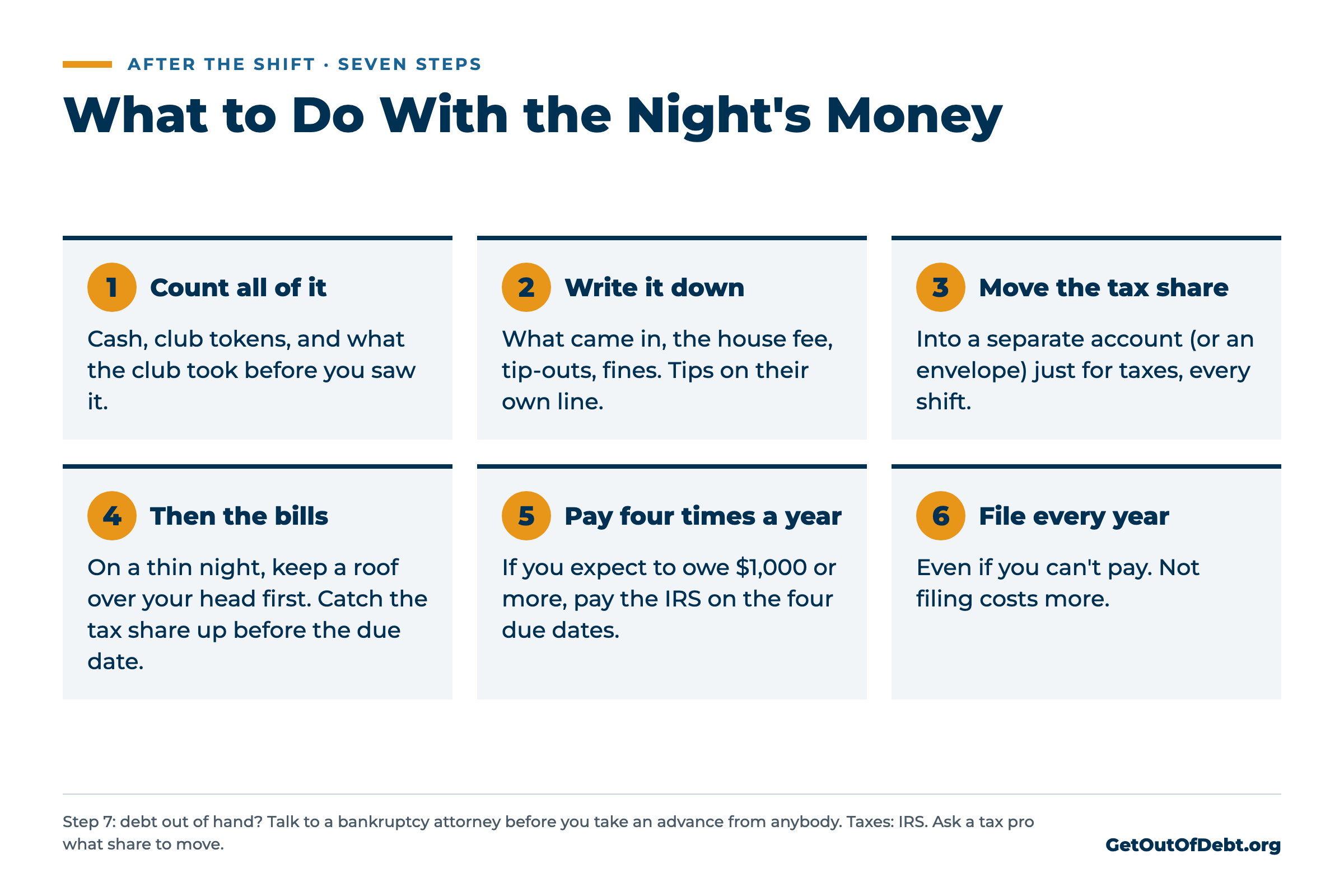
You just finished a shift and you’re holding the night’s cash. Here’s the routine, in seven steps. The first four happen every shift. The last three, a few times a year.
1. Count it. All of it.
Before you spend a dollar. What’s in your hand, and what the club took before you saw it. That funny money some clubs use counts too: the IRS says cash tips include “tangible or intangible tokens that are readily exchangeable for a fixed amount (such as casino chips),” and for a self-employed person they’re “generally included in the individual’s gross receipts and reported as business income on Schedule C” (IRS). So every dollar a customer pays for you, in your hand or through the club, is income. Not just what you took home.
2. Write it down.
What came in, and what went out. The house fee. The tip-outs. Any fines. Keep the tips on their own line, apart from dance fees. One line a night, in a notebook or your phone.
You might be thinking, “Doesn’t the club tell the IRS what I made?” Honestly, it depends on the club, and I haven’t found anything that says how clubs handle it. It doesn’t change whether you report it. The IRS says you report income even if it is “Not reported on an information return form” and even if it was “Paid in any form, including cash” (IRS). Your note might be the only record of your night.
And here’s the part nobody tells you. If nobody’s taking taxes out of what you make, you may be a business as far as taxes go. The label on your contract isn’t what decides it. Until a tax pro says otherwise, you’re the payroll department.
3. Move the tax share into its own account.
Open a second bank account, only for taxes. Nothing goes in but the tax share, and the only thing that comes out is the tax payment. No bank account? Then an envelope you never touch for anything else.
On top of income tax, you owe self-employment tax, your Social Security and Medicare. The IRS puts it at 15.3%: 12.4% for Social Security and 2.9% for Medicare, once your net earnings from self-employment are $400 or more, figured on Schedule SE (IRS). Net earnings means your profit after business costs. With a boss, you’d pay half and the boss would pay the other half. On your own, it’s all on you.
How much should you move? Ask a tax pro; I’m not going to hand you a percentage. Until you’ve asked, move something every shift anyway. Can’t afford a tax pro? The IRS’s VITA program offers “free basic tax return preparation,” though what each site handles varies, so ask whether it does self-employment returns (IRS, VITA). If you’re already in a dispute with the IRS, a Low Income Taxpayer Clinic can “represent you before the IRS or in court on audits, appeals, tax collection matters, and other tax disputes,” for free or a small fee, if your income is low enough.
What About “No Tax on Tips”?
There’s a real break, and a temporary one. The IRS says the deduction “applies to tax years 2025 through 2028” and “The maximum annual deduction is $25,000 per return.” It lowers the income you pay income tax on, not your tax bill dollar for dollar. And “The deduction phases out for taxpayers with modified adjusted gross income over $150,000 ($300,000 for joint filers).”
Club dancers are on the list. Treasury’s final rule, published April 13, 2026, lists “Dancers” with “Club dancer” as an example (Federal Register). Part of the rule isn’t finished: the law leaves out tips earned in a “specified service trade or business,” and the final regulations “do not address” that part yet. Until it does, the IRS treats people in listed tipped jobs, employees and self-employed alike, as outside that exclusion, under Notice 2025-69. So right now you count, and that could change.
Here’s the catch for you. Cash that never shows up on a tax form is still your income. It just doesn’t get the break. If you’re a contractor, your tips have to show up on a 1099 form you’re given. After 2025, the form has to list them separately as tips: the rule says amounts “that are not separately reported to an individual on a statement furnished to the individual” are “not eligible for the deduction.” (The rule’s other route, Form 4137, is how employees report tips.) For 2025 returns only, the IRS loosened that, because 2025 forms don’t break tips out. Your tips can count if they’re “included in the total amounts reported” on a 1099-NEC, 1099-MISC or 1099-K you were given, and you back up the amount with records like “daily tip logs” (IRS Notice 2025-69). Ask a tax pro. A price the club set for a dance is a fee, not a tip; only the extra a customer chooses to leave can count. Porn is left out (“Any amount received for pornographic activity is not a qualified tip”), and the rule doesn’t define where that line is. And the break “does not apply for Self-Employment Contributions Act (SECA) purposes,” so your self-employment tax doesn’t budge. Don’t set aside less for taxes because of it.
4. Then the bills.
Rent. The car. Whatever’s due. On a thin night, keep a roof over your head first. Catch the tax share up on the next good night, well before the next quarterly due date. Skipping a transfer isn’t skipping the payment, and the payment has a date.
The IRS says a business expense has to be “ordinary and necessary” (IRS Publication 334). The house fee and tip-outs may count against what you made if they’re a normal cost of the job. Outfits and everything else? Ask a tax pro. I didn’t find an IRS page that rules on those for dancers. Keep any receipt with tonight’s note. If there isn’t one, your note is the record: the date, who you paid, how much and what for.
Keep it all longer than you’d think. The IRS says to keep records 3 years in general, 6 years if you leave out income that “is more than 25% of the gross income shown on your return,” and “indefinitely if you do not file a return” (IRS).
5. Four times a year, pay the IRS.
Out of that tax account. If you expect to owe tax of $1,000 or more when you file, the IRS says you generally have to make estimated tax payments (IRS). The due dates are April 15, June 15, September 15 and January 15 of the following year. Skip them and “you may be charged a penalty even if you are due a refund.” Put those dates in your phone tonight, and check whether your state wants estimated payments too.
6. File every year, even if you can’t pay.
The penalty for not filing is a lot bigger than the one for not paying. The IRS failure-to-file penalty is “5% of the tax due … for each month or partial month the return is late,” up to 25% (IRS). The failure-to-pay penalty is “0.5% of the unpaid taxes for each month or part of a month,” also capped at 25% (IRS). I went through that math in why you should file even when you can’t pay the IRS.
On an extension? October 15 is the last day to file, and the IRS says “The extension is only for filing your return.” Any tax you owed was due in April (IRS).
Filing matters in bankruptcy too. Old income tax years can sometimes be wiped out. Roughly, all of these have to be true: the return was due (counting extensions) more than three years before you file, the tax was assessed more than 240 days before you file, there was no fraud or evasion, and if you filed the return late, you filed it more than two years before the bankruptcy (11 U.S.C. 507(a)(8), 11 U.S.C. 523(a)(1)). A year you never filed a return for can’t be wiped out. And if the IRS made up a return for you because you didn’t file, that doesn’t count as you filing: the bankruptcy law says a “return” “does not include a return made pursuant to section 6020(b),” the section the IRS uses when someone doesn’t file. Even a late return is a fight; some federal appeals courts have held it isn’t a “return” at all, and courts don’t all agree. More in when tax debt can actually be wiped out in bankruptcy. Already behind? File now anyway, and ask a bankruptcy attorney about your old years.
7. If the debt’s already out of hand, talk to a bankruptcy attorney.
Before you take an advance from anybody. That includes the club. If anyone offers you an advance, read what happens if you quit or get fired before you sign. If the whole balance comes due the day you leave, that debt is tied to your job.
Think about the trade. Credit cards, medical bills and payday loans are the kinds of debt a Chapter 7 bankruptcy can often wipe out. It isn’t automatic: the federal courts say a discharge “releases individual debtors from personal liability for most debts,” and that it “is subject to many exceptions,” which is why you talk to a lawyer first (U.S. Courts). Now swap a credit card for an advance from the club. The club holds a balance over your job, and it may come due the day you leave. That club debt may still be something a bankruptcy attorney can deal with, so don’t assume you’re stuck. Ask before you sign.
If you already owe the club, get the balance and interest rate in writing, get a receipt for every payment, and keep one line per payment: the date, what you paid, what’s left. If the balance doesn’t match the contract, or fees show up you didn’t sign for, ask a consumer lawyer through the National Association of Consumer Advocates. Take a picture of anything you sign, that night. And in bankruptcy you list all your income, cash too.
I filed bankruptcy myself in 1990. It didn’t end my life. It gave me a fresh start. If your income goes up and down, I wrote about filing bankruptcy with irregular income.
You can find a bankruptcy attorney through the National Association of Consumer Bankruptcy Attorneys. If you want a free second opinion first, my podcast co-host Damon Day does free consultations. You schedule one at damonday.com. He doesn’t sell anything, and I don’t get paid for sending you. The Ask Steve chat on my site is free too. It isn’t a lawyer, though, and my privacy policy says I may share information “If required by law, subpoena, or court order.” So use it for the debt question, and take details of work that may be illegal to a lawyer.
Free Tool — Contract Decoder: Have a contract from a debt relief company? The free Contract Decoder analyzes it for red flags, hidden fees, and problematic terms — before you sign anything. Decode My Contract →
Contractor or Employee? Look at Your Own List
Remember that list you wrote? Somebody set those fees and fines. For taxes, the big question is control. The IRS asks, “Does the company control or have the right to control what the worker does and how the worker does his or her job?” (IRS).
If the club sets your schedule, your prices and your fines, you might be an employee, not a contractor. In a wage case, a federal appeals court found dancers at two clubs in Prince George’s County, Maryland, were employees under federal wage law, in McFeeley v. Jackson Street Entertainment (4th Cir., June 8, 2016). They had signed agreements calling them independent contractors. The clubs dictated schedules, had guidelines with penalties, set private-dance prices and paid no wage. A jury awarded the dancers unpaid wages, and the appeals court affirmed. That’s one case, and not every club runs that way. It was a wage case under the Fair Labor Standards Act, not a tax ruling, so keep setting money aside for taxes until a tax pro says otherwise.
If you are an employee, your employer generally has to make sure your cash wage plus your tips reaches at least the federal minimum wage, and “An employer may not keep tips received by its employees” (29 U.S.C. 203(m)(2)).
If you think your label’s wrong, ask your state labor department or an employment lawyer. If you win a federal wage case, the court allows “a reasonable attorney’s fee to be paid by the defendant” (29 U.S.C. 216(b)), so ask how they charge before you assume you can’t afford one. Don’t sit on it: federal wage claims generally have to be brought within two years, three if the violation was willful (29 U.S.C. 255). Your state’s rules are their own. You can also ask the IRS to decide with Form SS-8, which either you or the business can file. But the IRS “attempts to get information from all parties involved by sending those parties blank Forms SS-8,” and what you write “may be shared with the other parties” (Form SS-8 instructions). So the club will hear about it; talk to the lawyer first. And it decides your tax status, not your wage claim. The IRS says “it may take at least six months.” Any contract that says you owe it all if you leave? Put it in front of the same lawyer.
Escorts and OnlyFans Creators: Same Routine, Two Differences
If that’s you, it’s the same seven-step routine, cash or payout. Two things are different.
First difference: the taxes
Even if the work isn’t legal where you live, the income still goes on your return. IRS Publication 17 says, “Income from illegal activities, such as money from dealing illegal drugs, must be included in your income on Schedule 1 (Form 1040), line 8z, or on Schedule C (Form 1040) if from your self-employment activity” (IRS Publication 17). If the work isn’t legal where you do it, talk to a lawyer before you file, about how to describe it on your return. Keep reporting the income; that part doesn’t change.
No form doesn’t mean no tax. OnlyFans might send you a 1099 form. It might not. Either way, you report every dollar. A payment app or online marketplace has to send a Form 1099-K when your payments “total over $20,000 in more than 200 transactions” (IRS), but the IRS says that threshold “doesn’t affect whether payments are taxable” (IRS).
The tips break, for creators. You’re on Treasury’s list too: “Digital Content Creators,” with “Streamer, online video creator, social media influencer, podcaster” as examples, and the same Notice 2025-69 treatment applies for now. But:
- If they have to pay to see it, it isn’t a tip. A payment “required to access” content “is not a qualified tip but rather a payment for services.” Still income, no break.
- Tips must be “paid voluntarily and without any consequence in the event of nonpayment” and “are not the subject of negotiation.” The price you agreed on for a custom video is a sale. A voluntary extra on top, with nothing held back if they don’t send it, can still be a tip. Keep the two apart in your notes.
- “Any portion of a user’s payment that is retained by a host platform … is not a qualified tip.”
- As with dancers, the tips have to show up on a 1099 form they send you, listed separately as tips after 2025 (2025 has the looser rule above).
What the porn exclusion costs you. A dancer whose tips qualify can take up to $25,000 of them off what she pays income tax on (less once her modified adjusted gross income passes $150,000, or $300,000 on a joint return). If your content is porn, you can’t. And neither of you gets out of self-employment tax. Treasury only says it “will consider whether to provide additional guidance” on where the porn line is, so if your content might be on that side, plan as if you don’t get the break, and ask a tax pro.
Prostitution doesn’t get the break either: “Any amount received for prostitution services is not a qualified tip,” and the rule doesn’t say “only where it’s illegal.” Same for “a service the performance of which is a felony or misdemeanor under applicable law.” Escort? The rate you and a client agree on is a fee, not a tip. And skipping this break doesn’t make any of it tax-free. Every dollar is still income.
Second difference: the law
Short, because I’m not a lawyer. In most of the U.S., selling sex is a crime. Two exceptions I checked. Maine repealed its crime of “Engaging in prostitution” in 2023 (17-A M.R.S. 853-A), but paying for sex is still a crime there (853-B). And Nevada allows it only in a licensed brothel. Don’t lean on Nevada’s tax law either. Its “Escort” definition, someone paid to “accompany” others, “does not include” anyone who provides “acts of sexual conduct to a patron” (NRS 368A.057). That’s a tax definition. It doesn’t make anything legal. Even in Nevada, “It is unlawful for a prostitute to engage in prostitution or solicitation therefor, except in a licensed house of prostitution” (NRS 201.353), and a county of 700,000 or more people can’t license one (NRS 244.345(8)).
Where you live, it’s your state’s law. Ask a lawyer there. And if the work isn’t legal where you do it, ask that lawyer how to keep your records, and how to describe the work on your tax return and bankruptcy papers, before you file either one.
Bankruptcy is on the table for you too. But the forms ask you to “Fill in the total amount of income you received from all jobs and all businesses, including part-time activities,” for “this year or the two previous calendar years” (Official Form 107), and you sign that form and your schedules under penalty of perjury (Official Form 106Dec). So talk to a bankruptcy attorney before you file. Tell them what you do.
This matters more than the money. If somebody else controls your money, or your ID, or watches where you go and who you talk to, that’s not a money problem. The National Human Trafficking Hotline lists signs like someone who doesn’t “have control of their passport or other identity documents” and a person “who monitors their movements, spending, or communications.” If someone may be watching your phone, the hotline’s own safety page says public computers “at local public libraries or community centers are more difficult to trace,” and that your browser history “should be cleared after every session.” To reach the hotline: call 1-888-373-7888, or use the live chat at humantraffickinghotline.org. The hotline says “All calls are confidential,” and it answers 24 hours a day, 7 days a week. Or text 233733 (message and data rates may apply). TTY: 711. If you’re under 18, the hotline says force, fraud or coercion “need not be present” for it to be trafficking. If you’re in danger right now, call 911.
Dancer, Escort, Creator: Take What Fits You
If you’re new to this work, you’re not stupid. You’re new. The club has done this a lot more times than you have. Handling the money like a business, so the taxes get paid, is how you even it up. That’s a money habit, not a ruling that you’re a contractor.
If you signed a bad deal, there’s no sense wasting a perfectly good mistake. Learn from it, and look to the future rather than spend five years repairing the past. And remember, you are not your debt.
I also write a free weekday email called Your Money Actually, at yourmoneyactually.com. And if gig work is part of your mix, Damon and I talked through the math to run before you start.
Key Takeaways
- Every dollar a customer pays for you is income, form or no form. Move a tax share every shift; ask a tax pro how much.
- Pay estimated tax four times a year if you expect to owe $1,000 or more, and file every year even if you can’t pay.
- The tips deduction lists dancers and creators, up to $25,000 off taxable income, less above $150,000 of modified adjusted gross income ($300,000 joint). It needs tips on a 1099 you’re given, excludes porn and prostitution, and never cuts self-employment tax.
- Debt out of hand? Talk to a bankruptcy attorney before you borrow from anybody, including the club.
Frequently Asked Questions
Does the club report my cash tips to the IRS?
It depends on the club, and I haven’t found anything that says how clubs handle it. Either way, the IRS says you must report income even if it is “Not reported on an information return form” and even if it was “Paid in any form, including cash.”
Do strippers get the “no tax on tips” deduction?
For now, yes: club dancers are on Treasury’s list, and the deduction covers tax years 2025 through 2028, but part of the rule isn’t finished, so that could change. It’s a deduction from the income you pay income tax on, not a dollar-for-dollar cut in your tax bill, and it never lowers self-employment tax. As a contractor, your tips have to be on a 1099 form you were given: for 2025, included in that form’s total and backed by records like a daily tip log; after 2025, listed separately as tips. A price the club set is a fee, not a tip, and cash on no form is still income, just without the break. The deduction phases out above $150,000 of modified adjusted gross income ($300,000 joint), and porn is excluded, with no definition of where that line is. Ask a tax pro.
How much should I set aside for taxes as a dancer?
Ask a tax pro, and move something into a separate tax account every shift until you do. Self-employment tax alone is 15.3% once net self-employment earnings reach $400, and income tax comes on top of that.
Do OnlyFans creators have to pay taxes if they don’t get a 1099?
Yes. You report all of your income whether or not a form arrives; the IRS says the 1099-K threshold “doesn’t affect whether payments are taxable.”
Can bankruptcy wipe out taxes I owe from dancing?
Sometimes, for old income tax years. Roughly, all of these have to be true: the return was due, counting extensions, more than three years before you file; the tax was assessed more than 240 days before; there was no fraud or evasion; and if the return was late, you filed it more than two years before the bankruptcy. Even a late return is a fight: some federal appeals courts have held it isn’t a “return” at all, and courts don’t all agree. A year you never filed can’t be wiped out, and a return the IRS made up for you doesn’t count as filing, so ask a bankruptcy attorney where you live.
This is what I’m telling friends like you over coffee. Take it as input, not instruction, and remember, you do you.
Send this to somebody who dances, or who just started. They’re the ones nobody explains this to.
Dealing With Debt? Understanding your options is the first step. See how all your debt relief options compare — including ones most sites won’t tell you about. The Find Your Path quiz gives a recommendation based on your actual numbers, and the Scam-O-Meter checks any company’s complaint history before you sign. Federal Reserve Bank of New York research shows bankruptcy filers recover faster than those who don’t file.