
Fact-checked by Steve Rhode, consumer debt expert since 1994 • Last reviewed October 15, 2026 • Every legal claim below links to the regulation, the statute or the agency page it comes from.
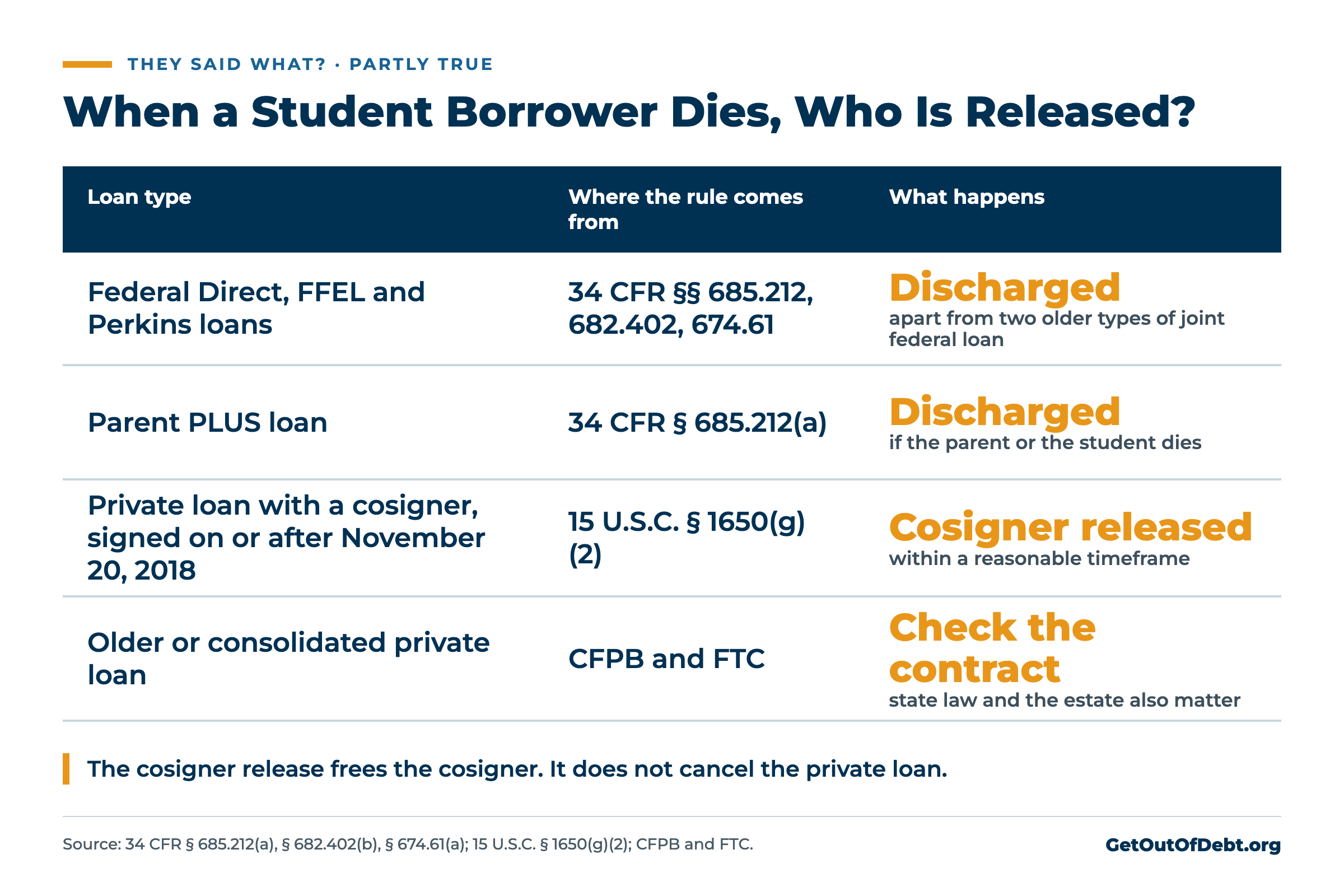
The verdict: Partly true. A federal student loan is discharged when the borrower dies, and a Parent PLUS loan is discharged if that parent or the student dies (34 CFR § 685.212(a)) — the exceptions are two older types of joint federal loan, covered below. Private student loans have no such rule: the contract decides, except that the holder of the loan must release a cosigner within a reasonable time after it is notified the student has died, and only on loans signed on or after November 20, 2018 (15 U.S.C. § 1650(g)).
Well, Actually…
This is a belief I hear from people at the worst possible moment: a parent who just lost a child, a widow sorting through the mail, a cosigner who got a letter from a lender a month after the funeral. Debt is math wrapped in emotion, and nowhere is that more true than here. So let me give you the math, one loan type at a time, because the answer really is different for each.
Federal loans: the belief is mostly right. The Department of Education’s Direct Loan regulation says that if a borrower dies, “the Secretary discharges the obligation of the borrower and any endorser to make any further payments on the loan” (34 CFR § 685.212(a)(1)). The older federal programs have parallel rules: for FFEL loans the regulation says the obligation of the borrower and any endorser “to make any further payments on the loan is discharged” (34 CFR § 682.402(b)(1)), and for Perkins loans an institution “must discharge the unpaid balance” (34 CFR § 674.61(a)(1)). The CFPB puts it in plain English: “If you have federal student loans and pass away, the loans won’t transfer to another person. Relatives can notify the loan servicer, and the loan will be canceled” (CFPB, last reviewed April 15, 2024).
Parent PLUS is the one people miss. The Direct Loan rule covers a borrower “(or a student on whose behalf a parent borrowed a Direct PLUS Loan)” — so the loan is discharged if the parent dies or if the student the parent borrowed for dies. StudentAid.gov says the same thing. One wrinkle: if a PLUS loan was rolled into a Direct Consolidation Loan and the student dies, what gets discharged is the part of that Direct Consolidation Loan “attributable to that Direct PLUS Loan or Federal PLUS Loan” (§ 685.212(a)(3)), not necessarily the whole balance.
The two older federal exceptions. Both are older types of joint federal loan, meaning more than one borrower is on the loan, and in both a surviving co-borrower can still owe. First, a joint consolidation taken out by a married couple: when one spouse dies, the regulation discharges only the portion “attributable to any of that borrower’s loans” that the joint loan repaid (34 CFR § 685.220(l)(3)(i), which applies to joint Direct Consolidation Loans from applications received before July 1, 2006; the FFEL version is § 682.402(a)(2)). Second, an older FFEL PLUS loan that two parents obtained as co-makers: if only one of them dies, “the other borrower remains obligated to repay the loan unless that borrower would qualify for discharge of the loan under these regulations” (§ 682.402(a)(3)). If you think you have one of those, ask the servicer in writing whether the loan is a joint consolidation or a two-parent PLUS loan, and what balance remains and who owes it.
Private loans: the belief is only partly right. The same CFPB page says that “private student lenders are not legally required to cancel private student loans for borrowers who die or become disabled,” and that “in some instances, private student loan debt may pass on to a spouse or cosigner of the loan.” But there is a federal rule that page does not mention. Since 2018, 15 U.S.C. § 1650(g)(2)(A) says: “The holder of a private education loan, when notified of the death of a student obligor, shall release within a reasonable timeframe any cosigner from the obligations of the cosigner under the private education loan.” The catch is the effective date. Congress wrote that the amendments “shall only apply to private education loan agreements entered into on or after the date that is 180 days after the date of enactment” — and the law was enacted May 24, 2018, so 180 days later is November 20, 2018. A cosigner on a private loan signed before that date is not covered by this rule, and what happens to them depends on the loan contract and state law.
Notice what that release does not say. It frees the cosigner. It doesn’t cancel the loan. The FTC explains the general rule: “a person’s debts do not go away when they die. Those debts are owed by and paid from the deceased person’s estate,” and “family members usually don’t have to pay the debts of a deceased relative from their own money. If there isn’t enough money in the estate to cover the debt, it usually goes unpaid” (FTC, Debts and Deceased Relatives). The same FTC page lists the exceptions — including if you “cosigned the obligation” — and says a spouse living in a community property state, such as California, may also be personally responsible. So the full picture is: a federal loan ends at death (apart from the two older joint-loan exceptions), a cosigner on a covered private loan signed on or after November 20, 2018 is released when the holder is notified, and the rest is a matter of the contract, the estate and state law.
When a student loan borrower dies, the debt dies with them, so no relative or cosigner can ever be stuck paying it.
A federal student loan is discharged on the borrower’s death (the exceptions are two older types of joint federal loan), and a Parent PLUS loan is discharged on the death of the parent or the student. A private lender isn’t required to cancel the loan, but the holder must release a cosigner within a reasonable time after it is notified of the student’s death — on private education loan agreements entered into on or after November 20, 2018. Older private loans, and anyone who isn’t a cosigner, depend on the contract and state law.
Where the Private-Loan Rule Stops Helping
Before you assume a cosigner is off the hook, check four places where the 2018 rule does not clearly reach.
- The loan was signed before November 20, 2018. The release rule applies only to agreements entered into on or after that cutoff. Look at your contract, because some lenders write their own death release into it. The CFPB says: “In certain cases, private lenders have special provisions to discharge loans.”
- The loan was a consolidation or refinance of private loans. The statute’s definition of “cosigner” carves out “an obligation under a private education loan extended to consolidate a consumer’s pre-existing private education loans”. I would not assume the release applies to a refinanced loan — ask the lender in writing and, if the balance is large, ask an attorney.
- The paperwork calls you a “co-borrower,” or the student isn’t on the loan at all. The statute defines a “cosigner” as an individual “liable for the obligation of another without compensation, regardless of how designated in the contract or instrument,” so the label alone doesn’t settle it either way. And the rule is triggered by the death of a “student obligor,” so by its words it has nothing to say about a loan taken in a parent’s name only. If you aren’t sure which you are, ask the lender in writing and ask an attorney.
- The student’s federal loan was paid off with a private loan. The death-discharge regulations I quoted govern the federal loans, so once a federal loan has been paid off by a private one, that federal discharge is gone. Whether the 2018 cosigner rule reaches the new loan isn’t clear to me from the statute, so ask the lender in writing whether its contract releases a cosigner on death.
Why You Were Told This
The belief isn’t made up; it’s a true statement about federal loans that got stretched to cover every loan. The federal rule is clean and simple, so the shorthand “the debt dies with you” travels without the private-loan footnote. The footnote itself is recent: the cosigner-release subsection was added to the statute in 2018, and the CFPB page I quoted, last reviewed in April 2024, doesn’t mention it. I don’t see a villain in this one. The cost of the myth is quieter: a cosigner who keeps paying a lender that may already be required to let go, or a parent who leaves a Parent PLUS balance sitting because they assume the paperwork is only for the borrower.
What to Actually Do
- Find out which kind of loan it is, and for private loans, the date. The promissory note and the latest statement name the lender or servicer, tell you whether it’s federal or private, and show the date of the agreement. For a private loan signed on or after November 20, 2018, the cosigner-release rule generally applies, unless one of the exceptions above applies.
- Federal loan: send the servicer proof of death. The regulation accepts “an original or certified copy of the death certificate,” an accurate photocopy, a scanned copy, or verification through an approved federal or state database (34 CFR § 685.212(a)(1)). Per StudentAid.gov, a family member or other representative can send it.
- Federal loan: ask in writing for any payments made after the discharge requirements were met. The Direct Loan regulation says the Secretary “returns to the sender, or, for a discharge based on death, the borrower’s estate, any payments received after the date that the eligibility requirements for discharge were met” (§ 685.212(g)(1)). If the borrower died, the regulation’s recipient is the borrower’s estate. If a Parent PLUS loan was discharged because the student died, the parent borrower is alive and the regulation’s general recipient is the sender, meaning whoever sent the payments. Ask the servicer in writing to return them, and if a relative paid from their own money, say so in the request.
- Private loan with a cosigner: give written notice of the death and ask for the release in writing. Cite 15 U.S.C. § 1650(g)(2) if the agreement is dated on or after November 20, 2018. The statute requires the holder or servicer to notify a cosigner “within a reasonable time-frame” once the cosigner is released, so ask for that confirmation and keep it. The statute doesn’t set a number of days; “reasonable” is all it says.
- Know who a collector may talk to before you answer the phone. The FTC’s plain-language summary of the FDCPA is that collectors “can contact and discuss outstanding debts only with the deceased person’s” spouse; parent or parents, if the deceased was a minor child; legal guardian; lawyer; executor, administrator or personal representative with the power to pay debts from the estate; or confirmed successor in interest (the FTC’s gloss: someone a mortgage servicer has confirmed as a new owner of the deceased person’s real estate). The FTC page adds: “Debt collectors may not discuss the debts of a deceased person with anyone else.” A collector may contact a relative to get the name and contact details of the person handling the estate, but should not discuss the debt with them. Whoever calls, you don’t have to agree on the phone to pay a relative’s loan from your own money; ask who is calling and ask for it in writing.
- Ask a tax professional about the discharge. For discharges after December 31, 2025, the Internal Revenue Code excludes a discharged student loan or private education loan from federal gross income when the discharge is on account of the death of the student (the statute lists other qualifying discharge routes too), and the exclusion depends on a Social Security number on the return. Whether a discharge because the parent died qualifies depends on whether it falls under one of the Higher Education Act discharge routes the statute lists; the “of the student” wording alone doesn’t cover it, so ask a tax professional, including which return it goes on. Details are in the FAQ below, and state tax is a separate question.
- Stuck on an older cosigned loan? Talk to an attorney before you pay out of your own pocket. Bankruptcy is one of the tools, and student loans can be discharged in bankruptcy — my explainers cover the undue-hardship route and why some private loans may not fall under the exception at all. Whether a given loan does is a question for a bankruptcy attorney who has read the loan documents.
While the student is alive: § 1650(g)(2)(C) requires a private lender to give the student obligor “an option to designate an individual to have the legal authority to act on behalf of the student obligor” in the event of the student’s death, so a student with a private loan can ask about it now.
Steve’s Take
Nobody should have to learn this while they’re grieving, and nobody should feel ashamed for not knowing it. You are not your debt, and neither is the person who died. What I want you to leave with is simple: find the loan type, find the date, and put the notice in writing. The federal side is a paperwork job, not a negotiation. The private side rewards the person who asks the right question in the right words — and that’s no reason to be intimidated by a lender’s letter. If a balance is still being demanded from you after all that, run the numbers with an attorney before you decide to pay it, because the options are wider than most lenders will tell you. Take it one piece of paperwork at a time.
Frequently Asked Questions
If my child dies, do I still owe the Parent PLUS loan I took out for them?
No, not for a federal Parent PLUS loan. The Direct Loan regulation covers “a student on whose behalf a parent borrowed a Direct PLUS Loan,” so the loan is discharged when the student dies, and it is also discharged if the parent dies (34 CFR § 685.212(a)(1)). If the PLUS loan was consolidated, only the portion of the Direct Consolidation Loan attributable to the PLUS loan is discharged on the student’s death. A private loan a parent took out for a child is a different matter and follows the private-loan rules above.
Do federal student loans really disappear when the borrower dies?
Yes, apart from two older types of joint federal loan. The regulation says the Secretary “discharges the obligation of the borrower and any endorser to make any further payments on the loan” once the servicer has proof of death (34 CFR § 685.212(a)), and the CFPB says that federal student loans “won’t transfer to another person.” Parallel rules cover FFEL loans (§ 682.402(b)) and Perkins loans (§ 674.61(a)). Two older exceptions exist: a joint consolidation taken out by a married couple (only the deceased spouse’s share is discharged) and an older FFEL PLUS loan obtained by two parents as co-makers (if only one parent dies, the surviving parent still owes it unless that parent otherwise qualifies for discharge). If it is the student who died, § 682.402(b)(1) discharges an FFEL PLUS loan when “the student for whom a parent received a PLUS loan dies.”
I cosigned a private student loan and the student died. Do I have to keep paying?
If the loan agreement was entered into on or after November 20, 2018, the holder “shall release within a reasonable timeframe any cosigner” once it is notified of the student’s death (15 U.S.C. § 1650(g)(2)(A)), so give written notice and ask for the release in writing. If the loan is older, or was a consolidation or refinance, that rule may not apply and the contract and state law decide, so read the contract and talk to an attorney before you keep paying.
Does the private loan itself get canceled when the student dies?
Not by federal law. The CFPB says “private student lenders are not legally required to cancel private student loans for borrowers who die or become disabled,” and adds: “In certain cases, private lenders have special provisions to discharge loans.” Check the contract or ask the servicer. The cosigner-release statute frees the cosigner; it says nothing about cancelling the balance, which the FTC says is generally owed by and paid from the deceased person’s estate.
What if the cosigner dies instead of the student?
For a covered private loan, the statute says the creditor “shall not declare a default or accelerate the debt against the student obligor on the sole basis of a bankruptcy or death of a cosigner” (15 U.S.C. § 1650(g)(1)). That is a limit on declaring default for that one reason; the student still owes the loan, and it applies only to agreements entered into on or after the same cutoff.
Can a debt collector make my parents or siblings pay my student loans after I die?
Generally not from their own money, unless they are personally liable, such as a cosigner. The FTC says “family members usually don’t have to pay the debts of a deceased relative from their own money.” Who a collector may discuss the debt with is in the “What to Actually Do” list above. The exceptions the FTC lists include being a cosigner and being a spouse in a community property state, such as California; state law varies, so ask a local attorney if you’re unsure (FTC).
Is a student loan that is discharged because of death taxable?
For federal income tax, discharges after December 31, 2025 are covered by a statute that says gross income does not include a discharged student loan or private education loan if the discharge was “on account of death or total and permanent disability of the student,” or was made under the Higher Education Act discharge provisions it lists. The exclusion doesn’t apply “unless the taxpayer includes the taxpayer’s social security number on the return of tax for such taxable year” (26 U.S.C. § 108(f)(5)). The statute doesn’t say whose return that is once the borrower has died. Whether a discharge because the parent died qualifies depends on whether it falls under one of the Higher Education Act discharge routes the statute lists; the “of the student” wording alone doesn’t cover it, so ask a tax professional, including which return it goes on. The current text comes from Pub. L. 119-21, § 70119, which applies “to discharges after December 31, 2025.” State tax treatment is a separate question. My post on student loan forgiveness and taxes in 2026 covers the other kinds of forgiveness.
Where can I read more about debts after someone dies?
My guide Debt After Death: The Complete Family Guide walks through what families actually owe, and What Happens to Your Debt When You Die? covers collectors. If the cosigner side is your problem, see the cosigner-and-bankruptcy myth and what to do when the borrower stops paying a cosigned loan.
This is one informed perspective from someone who has watched how this plays out since 1994 — not legal, tax or financial advice for your case. Only you can decide what’s right for your situation, and an attorney who has read your loan documents can tell you where you actually stand. Take this as input, not instruction, and make the call that serves your future.
The bottom line: A federal student loan ends when the borrower dies (apart from two older types of joint federal loan), and on a covered private loan signed on or after November 20, 2018 the holder must release a cosigner once notified of the student’s death — but a private loan is not automatically cancelled, and an older cosigned loan is decided by the contract. If someone you know still believes the debt always dies with the borrower, send them this page.
Dealing With Debt? Understanding your options is the first step. See how all your debt relief options compare — including ones most sites won’t tell you about. The Find Your Path quiz gives a recommendation based on your actual numbers, and the Scam-O-Meter checks any company’s complaint history before you sign. Federal Reserve Bank of New York research shows bankruptcy filers recover faster than those who don’t file.