Part of the Debt After Death Hub: This post is one piece of my complete Debt After Death: Complete Guide — what you actually owe when a family member dies, how to stop collector harassment, joint account rules, community property state rules, and the filial responsibility laws collectors invoke to scare you.
Quick Answer: When someone dies, their debts are paid from their estate — not by family members, not by children, not by the surviving spouse (with limited exceptions). Yet debt collectors call grieving families every day, hoping that grief and confusion will produce payments the law doesn’t require. Here’s what you actually owe, what dies with the person, and how to stop collectors from exploiting your loss.
Expert Context: I’ve helped people deal with debt since 1994, including running a credit counseling organization where we regularly advised surviving spouses and family members being pressured by collectors after a loved one’s death. The pattern was always the same: the collector called during the most vulnerable moment of the family’s life, and nobody had told them they probably didn’t have to pay.
Your spouse, parent, or family member just died — and a debt collector is already calling. They’re asking you to pay a credit card balance, a medical bill, a personal loan. The grief is still raw. The funeral costs are mounting. And someone on the phone is telling you that you’re responsible for debts you didn’t create.
Each weekday I send one short email: one money story that caught my attention, why it might matter to you, and one manageable thing you can do with it. A couple of minutes, and a dad joke.
In the latest issue (Oct 15): The ones who need the Social Security raise the most keep the least of it
Free. I sell nothing. Unsubscribe any time.
In most cases, you’re not.
The Consumer Financial Protection Bureau and the Federal Trade Commission both confirm: a deceased person’s debts are paid from their estate. Family members are generally not personally responsible unless they co-signed, held a joint account, or live in a community property state with specific exceptions.
But collectors call anyway. Because grief is leverage.
The Core Rule: Debts Belong to the Estate, Not the Family
Getting calls right now? If a debt collector is calling you about a dead relative’s debt, see the emergency crisis guide for exactly what to say and your rights under the FDCPA.
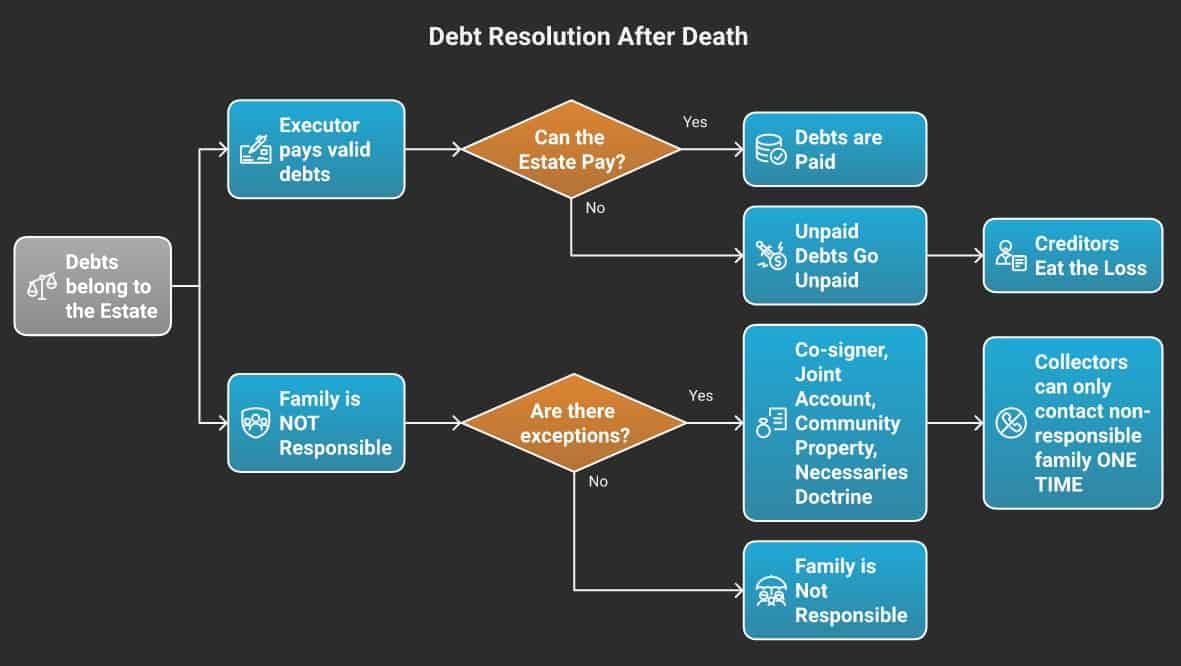
When someone dies, their debts don’t transfer to their children, siblings, parents, or friends. The debts belong to the estate — the legal entity that holds everything the person owned at death.
The executor (named in a will) or administrator (appointed by a court if there’s no will) is responsible for: (If your parent died without a will and you’re dealing with this right now, the financial emergency checklist for the first 30 days covers exactly what needs to happen and in what order.)
- Inventorying the estate’s assets
- Notifying creditors of the death
- Paying valid debts from estate assets
- Distributing whatever remains to heirs
If the estate doesn’t have enough money to pay all debts, the unpaid debts go unpaid. Creditors eat the loss. They cannot come after family members for the difference — unless one of the specific exceptions below applies.
Common Claim: “Your parent/spouse died with debt. As the closest relative, you’re responsible for paying it.”
What the Law Says: The FTC states plainly: “Family members typically are not obligated to pay the debts of a deceased relative from their own assets.” The estate pays. If the estate can’t, the debt generally goes unpaid. A collector telling you otherwise is either misinformed or hoping you don’t know your rights.
The Exceptions: When You ARE Responsible
There are four situations where a surviving family member may be personally responsible for a deceased person’s debt. The CFPB identifies each one:
You May Be Responsible If:
- You co-signed the debt. If you co-signed a loan or credit card application, you agreed to pay if the primary borrower couldn’t. Death doesn’t change that agreement.
- You’re a joint account holder. Joint credit card accounts (not just authorized users — there’s a difference) make both parties equally liable. Being an authorized user on someone else’s card does NOT make you liable.
- You live in a community property state. In these states, debts incurred during a marriage may be the responsibility of both spouses, even after one dies.
- Your state has a “necessaries” or “doctrine of necessities” law. Some states require spouses to pay for each other’s essential expenses (medical care, housing) regardless of whose name is on the bill.
Community Property States — The Biggest Exception
In community property states, both spouses share equally in income, assets, and debts acquired during the marriage. This means a surviving spouse in these states may be responsible for debts the deceased spouse incurred during the marriage — even debts in only the deceased spouse’s name.
The 10 community property states are:
Arizona, California, Idaho, Louisiana, Nevada, New Mexico, Texas, Washington, Wisconsin, and Alaska (if a special community property agreement was signed).
If you live in one of these states and your spouse died with debt, consult an attorney before paying anything. The rules are complex — some debts may qualify as “separate property” (incurred before marriage or after separation) and some assets may be protected.
What Collectors Can and Can’t Do After a Death
The FDCPA provides specific rules about contacting family members after a death:
- Cannot discuss debt details with anyone other than the executor, administrator, spouse, or parent (if deceased was a minor)
- Cannot contact non-responsible family members more than once — they get one call to find out who the executor is, period
- Cannot pressure you to pay from personal funds if you’re not legally responsible
- Cannot threaten legal action against you personally if the debt belongs to the estate
- Cannot misrepresent your legal obligation or claim you owe a debt you don’t
- Can contact the executor or administrator to file a claim against the estate
- Can file a claim in probate court to get paid from estate assets
- Can report the debt to credit bureaus against the deceased’s credit file
Debt collectors call grieving families because grief makes people pay debts they don’t legally owe. The call comes at the worst possible moment — when you’re least able to think clearly and most likely to say yes just to make the pain stop. That’s not a coincidence. It’s a strategy.— Steve Rhode
What to Do When a Collector Calls About a Deceased Person’s Debt
- Step 1: Don’t agree to pay anything on the phone. Say: “I need to review the estate’s legal obligations. Please send written documentation.”
- Step 2: Determine your legal relationship to the debt. Were you a co-signer? Joint account holder? Do you live in a community property state? If none of these apply, you’re likely not responsible.
- Step 3: Request debt validation in writing within 30 days. The collector must prove the debt is valid, the amount is correct, and that you (or the estate) actually owe it. Use our free Debt Validation Letter Generator.
- Step 4: If you’re the executor, handle debts through probate. Creditors must file claims with the probate court within the deadline your state sets (typically 3-6 months after notice). Debts not filed in time may be barred.
- Step 5: If you’re NOT the executor and NOT personally liable, send a cease-and-desist letter. Under the FDCPA, the collector must stop contacting you.
Free Tool — Debt Validation Letter Generator: Being contacted by a debt collector? The free Debt Validation Letter Generator creates a personalized FDCPA validation letter in seconds — forcing the collector to prove the debt is real before they can continue. Generate My Letter →
Specific Debt Types: What Happens to Each
Dies With the Person (Usually)
- Credit card debt in only the deceased’s name
- Personal loans with no co-signer
- Medical debt (unless necessaries doctrine applies)
- Student loans — federal loans are discharged upon death; some private loans too
May Transfer to Survivors
- Mortgage — the loan remains on the property (heir inherits both the house and the mortgage)
- Car loan — secured by the vehicle; lender can repossess if payments stop
- Joint debts — any co-signed or jointly held obligation
- Community property debts in the 10 states listed above
The Emotional Manipulation Collectors Count On
I need to say this directly: creditors are businesses that already priced your family member’s potential default into their profit model. They charged interest rates that included the cost of people dying with unpaid balances. When a collector calls your grieving family, they’re not absorbing an unexpected loss — they’re trying to recover money they already wrote off.
The guilt you feel isn’t evidence that you owe the debt. It’s a natural human response to loss that collectors know how to exploit. The question isn’t “What would my loved one have wanted?” The question is “What does the law actually require?” In most cases, the answer is: nothing from you personally.
If the debt stress from this situation is affecting your mental health, take this free debt stress screening — grief and debt pressure together can create a crisis that deserves attention.
Not sure what you’re legally responsible for? Take the free Find Your Path Out of Debt quiz — it can help clarify your options based on your specific situation.
Key Takeaways
- A deceased person’s debts belong to their estate, not their family. The CFPB and FTC both confirm this.
- Four exceptions exist: co-signers, joint account holders, community property states (10 states), and necessaries doctrine.
- Collectors can only contact non-responsible family members once — to find the executor. Repeated calls violate the FDCPA.
- Federal student loans are discharged upon death. No one inherits them.
- Don’t pay from personal funds without legal advice. Once you voluntarily pay a debt you don’t owe, getting that money back is extremely difficult.
The Bottom Line
When someone dies, their debts are paid from their estate — not by their family, not by their children, and usually not by the surviving spouse (unless you co-signed, held a joint account, or live in one of 10 community property states). The CFPB and FTC both confirm this. Yet debt collectors call grieving families every day hoping that confusion and guilt will produce payments the law doesn’t require. Under the FDCPA, collectors can only contact non-responsible family members once. If you’re not the executor and not personally liable, send a cease-and-desist letter and stop taking their calls. The creditor already priced this loss into their business model. Your loved one’s death is not your financial obligation — unless the law specifically says otherwise.
Frequently Asked Questions
Am I responsible for my spouse’s debts after they die?
Generally no — unless you co-signed, held a joint account, or live in a community property state (Arizona, California, Idaho, Louisiana, Nevada, New Mexico, Texas, Washington, Wisconsin, or Alaska with a special agreement). The CFPB confirms that debts are paid from the estate, not from the surviving spouse’s personal funds.
Can a debt collector contact my family about my dead parent’s debts?
Only to find the executor — and only once. Under the FDCPA, collectors cannot discuss debt details with anyone other than the executor, administrator, surviving spouse, or parent of a deceased minor. If they call more than once or pressure you to pay a debt you don’t owe, that’s a violation.
What happens to credit card debt when someone dies?
Credit card debt in only the deceased person’s name is paid from the estate. If the estate doesn’t have enough assets to cover it, the debt goes unpaid — the credit card company absorbs the loss. You are not responsible unless you were a co-signer or joint account holder (being an authorized user does NOT make you liable). For a complete explanation of why you almost certainly don’t owe your parent’s credit card debt, including the specific exceptions, see the full guide.
Do children inherit their parents’ debt?
No. Children do not inherit a parent’s debt. The estate pays what it can; unpaid balances are written off by creditors. The FTC confirms: “Family members typically are not obligated to pay the debts of a deceased relative from their own assets.” The only exception is if you co-signed a specific debt.
Are student loans forgiven when someone dies?
Federal student loans are discharged (forgiven) upon the borrower’s death — the loan servicer cancels the balance when provided with a death certificate. Many private student loan lenders also discharge loans upon death, though policies vary. Parent PLUS loans are also discharged if the student or the parent borrower dies.
Related: If you’re on disability and collectors are calling about your own debts, read On Disability With Debt? What Collectors Can’t Touch. If old debts from years ago are resurfacing, read Zombie Debt: What to Do When a Collector Calls About a 10-Year-Old Bill.
Part of the Debt Research Library: This post is one piece of my complete Debt Research Library — academic research on why consumers make the wrong debt choices, what outcomes actually show, and how to evaluate your options without a conflict of interest attached to the answer.
Free Tool — Statute of Limitations Checker: Dealing with old debt? The free Statute of Limitations Checker tells you if the collection clock has expired in your state — including the zombie debt and clock-restarting traps collectors use. Check My Status →
Sources
- CFPB — “Does a Person’s Debt Go Away When They Die?”
- CFPB — “Am I Responsible for My Spouse’s Debts After They Die?”
- CFPB — “Can a Debt Collector Contact Me About a Deceased Relative’s Debts?”
- CFPB — “When a Loved One Dies and Debt Collectors Come Calling”
- FTC — “Debts and Deceased Relatives”
- Nolo — “FAQs About Debt After Death”
- Nolo — “What Happens to My Debts After I Die?”
Know Your Rights: If a debt collector is contacting you, you have legal protections. See the complete list of FDCPA violations collectors commit most often. Use the free Debt Validation Letter Generator to demand proof of the debt, or check this collector’s complaint history with the Scam-O-Meter.
Dealing With Debt? Before you pay a collector, understand all your debt relief options — including ones the collector won’t tell you about. If the debt feels unmanageable, take the 2-minute bankruptcy quiz to see if the math favors a fresh start. Federal Reserve research shows filers recover faster than those who don’t file.
If your spouse just died and collectors are already calling: that’s its own emergency. See my crisis guide on what you actually owe (and what you don’t) when a debt collector calls after your spouse dies — including how to protect your Social Security.